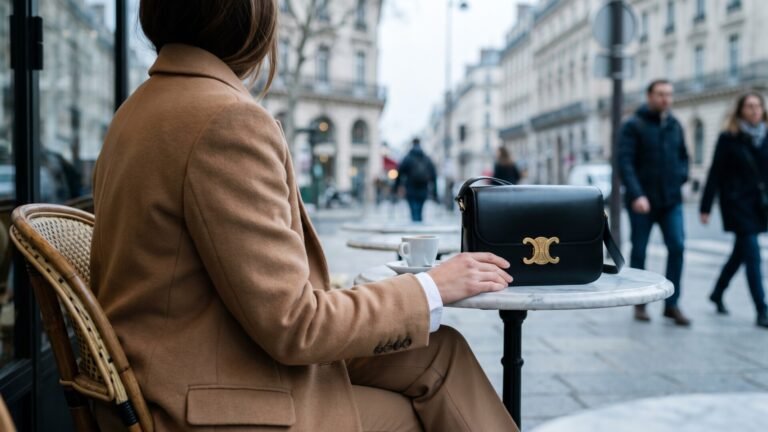
Celine Belt Bag vs 16 Bag: Which Is More Practical for Work?
The Celine Belt Bag is the more practical work bag for most people. The Celine 16 is the better work bag for a narrower group: those whose working lives are spent in tailored clothes, in rooms where a certain formality is expected, and whose daily load is modest. That is the whole tradeoff, and it does not take long to unpack. Both bags are restrained, both are leather, both cost real money. The difference is that one is designed around being carried and the other is designed around being seen, and most buyers discover which of those they actually needed only after a few months of ownership.
What follows concerns the current and commonly encountered configurations of each. Dimensions, leathers, and available sizes change by season, so treat any figure here as a starting point to verify against the exact bag in front of you.
Quick Verdict Summary
The Belt Bag wins on flexibility, weight, and everyday usability. The 16 wins on structure, presence, and the particular kind of confidence that a boxy, clasped bag gives a tailored outfit. Neither is a compromise purchase; they simply answer different questions.
Reasons to choose the Celine Belt Bag
- Better for daily commuting, lighter loads, and buyers who want a quieter, less formal silhouette.
- More approachable interior organization for a wallet, phone, keys, a small cosmetics case, and work accessories.
- Usually the better choice for readers who want one bag that moves between the office, lunch, and weekends without looking out of place anywhere.
Reasons to choose the Celine 16
- Stronger structured shape and more elevated presentation for executive, client-facing, or formal office environments.
- Better suited to buyers who value the recognizable 16 clasp, boxier proportions, and old-money styling.
- More convincing as a long-term investment piece when bought in a durable leather and maintained carefully.
Key takeaway: choose the Belt Bag for practical everyday work use. Choose the 16 when professional polish and structured design matter more than weight and flexibility.
Product Snapshot: What These Bags Are Actually Designed to Do
The first thing to understand about this comparison is that neither bag was designed as a laptop bag. They are handbags that happen to be smart enough for an office. That distinction decides most of what follows, and it is the reason so many buyers end up disappointed by a purchase that looked correct in a photograph. For category-level context on how these two sit among their peers, the guide to French handbags is the place to start, and the full Celine brand guide covers the house’s wider design language before you commit to a model.
Celine Belt Bag
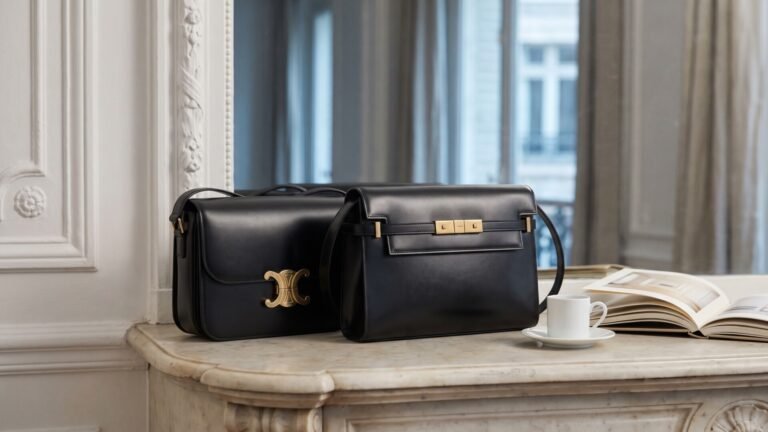
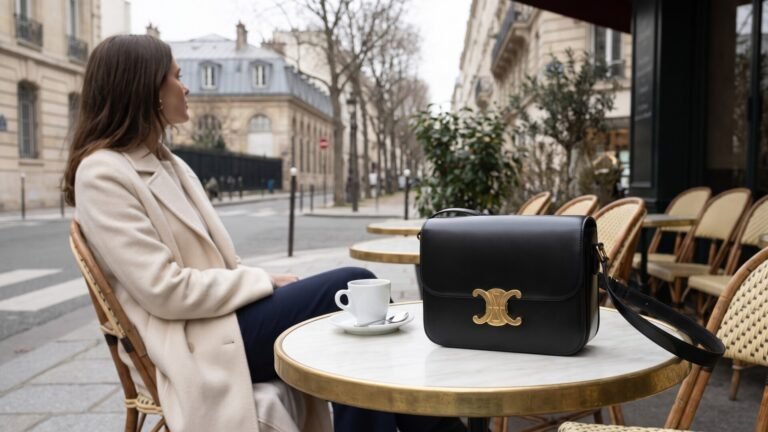
The Belt Bag has a clean, architectural silhouette with a curved front flap and a relatively relaxed body. It reads as polished without reading as corporate. The branding is minimal, the proportions are modern, and the bag looks as comfortable with knitwear and flat shoes as it does with a blazer.
Work suitability depends almost entirely on which size you choose. The larger configurations can take a tablet, a notebook, and the usual personal items. The compact versions are meeting bags or weekend bags, and treating them as commuter bags is where buyers get into trouble. The Belt Bag is also softer in construction than the 16, which makes it more forgiving to carry and less punishing to overfill, but also means it will not stand up on a desk with the same authority.
Celine 16
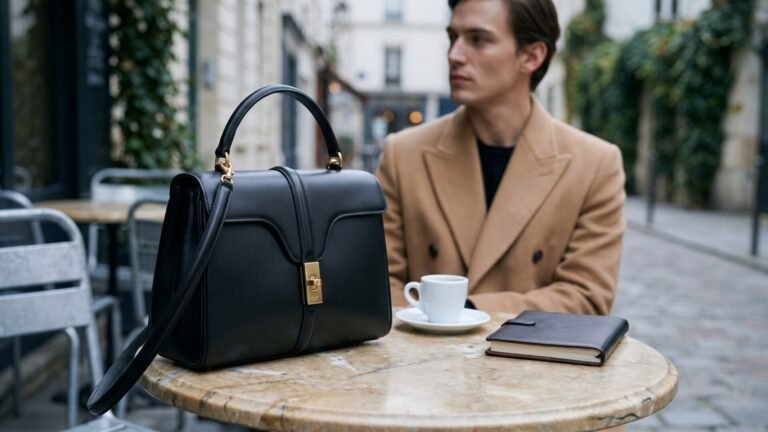
The 16 is a structured bag with a distinctive clasp, a top-handle orientation, and a more formal visual language. It looks like a bag that belongs in a meeting. The shape holds itself, the leather is firmer, and the closure is a piece of design rather than an afterthought.
It is not automatically the better work bag because it looks more substantial. Structure adds weight, and a rigid body does not expand around a bulky charger or a water bottle the way a softer bag will. Size and leather choice change the calculus considerably: a smaller 16 in smooth calfskin is a different object from a larger one in grained leather, and only one of them is a plausible daily carry.
The first buying decision: work essentials or professional presence?
Before comparing color, leather, or resale appeal, empty your current bag onto a table and look at it. That pile is the specification. Everything else is preference.
Three office scenarios cover most readers:
- The light commuter. Phone, wallet, keys, a small pouch, maybe a notebook. Either bag works; the Belt Bag is easier.
- The document-and-device carrier. Adds a tablet or compact laptop and a charger. Size becomes the deciding factor, and a separate sleeve is often the honest answer.
- The client-facing professional. Cares about how the bag reads in a room. The 16 earns its keep here.
A bag should not be judged as a work bag unless it holds your actual essentials without straining the closure or distorting the shape. If you are still working out which Celine size suits a given carry, the Triomphe size comparison is a useful exercise in how much capacity the house’s silhouettes actually deliver.
Celine Belt Bag for Work
Design and professional impression
The Belt Bag’s understated branding, curved flap, and softly architectural profile are the reason it works in a quiet-luxury wardrobe. It does not announce a price point. It looks considered rather than expensive, which is a different and generally more useful quality in an office.
It can appear less corporate than the 16 while still looking polished with tailoring, knitwear, or a minimalist work wardrobe. The tradeoff is real: its less rigid appearance feels more modern and more versatile, but it carries less authority in a highly formal setting. In a room full of suits, the 16 will be read first.
Interior capacity and organization
A wallet, phone, keys, sunglasses, a compact cosmetics case, a charger, a notebook, and a small water bottle will go into a larger Belt Bag without drama. The organization is approachable rather than engineered: a few compartments, a flat pocket, and enough open space to see what you are doing.
Fitting items and reaching them quickly are different problems. The Belt Bag’s flap closure is attractive and secure-looking, but it is slower than an open tote when you are entering an office, an airport, or a train carriage with a queue behind you. If you need to reach a transit card or a phone every ten minutes, this matters more than capacity.
Larger Belt Bag configurations are plausible work bags. Compact versions are better for meetings, for commuting with a separate laptop case, or for lighter office days when the laptop stays on the desk.
Carrying comfort and commute practicality
Where the specific configuration allows it, the Belt Bag can be carried by top handle or on the shoulder. The softer, less rigid profile is more forgiving on public transport and in crowded commutes; it gives slightly when it meets a stranger’s coat, and it does not turn into a battering ram on a busy platform.
The hidden inconvenience is the flap. It is the bag’s best design feature and its most frequent small irritation. A magnetic or open-top closure would be faster. It would also look cheaper, which is the trade the house made.
Materials, wear, and maintenance
Grained leather is the safer choice for frequent commuting. It takes a knock, hides a scuff, and does not show every fingerprint. Smooth leather gives a more refined appearance and shows scratches and handling marks more readily, which is a poor combination for a bag that lives under a desk or on a train seat.
Practical maintenance is unglamorous and effective. Avoid overfilling, which distorts the flap and stretches the leather at the base. Protect the corners, which is where wear appears first. Keep pressure off the flap when the bag is stored, and store it upright with the shape supported. A bag that is stuffed to capacity every day will look three years older than one that is not.
Celine 16 for Work
Design and professional impression
The 16 is the more formal and status-conscious option, and it knows it. The structured body and signature clasp give it a deliberate, executive presence that does not rely on a logo. It works particularly well with suiting, tailored coats, trousers, and understated jewelry. For readers drawn to that heritage-inspired, old-money register, the case for the Celine 16 as an old-money tote sets out the styling logic in more detail.
The downside of a stronger visual identity is that it does not disappear. The 16 can feel too formal or too precious in a relaxed office, and it makes casual clothing look intentionally dressed up. If your workplace is jeans and a good knit, this bag will look like a decision rather than an accessory.
Interior capacity and organization
A notebook, documents, a tablet, a compact laptop where dimensions permit, a phone, a charger, and a cosmetics case will fit in the larger 16 configurations. Interior capacity varies significantly by size and construction, and no photograph will tell you whether your laptop fits. Check the published internal measurements against your device in its sleeve, with the charger alongside.
A structured bag’s useful capacity is smaller than its apparent capacity. Rigid walls protect contents beautifully, but they do not expand around a bulky object. Where a softer bag would bulge and carry on, the 16 will refuse the closure, and forcing it is how handles and corner seams begin to fail.
Carrying comfort and access
Structured leather carries weight differently. A 16 with a laptop, charger, and water bottle becomes a heavy bag, and the top-handle orientation means that weight is on your hand or the crook of your arm rather than distributed across a shoulder. Elegant in a meeting. Less convenient on a thirty-minute commute.
The clasp is the design strength and the access compromise in one object. It creates the 16’s identity and makes it slower to open than a simple magnetic or open-top closure. In a meeting, nobody notices. At a ticket barrier, everybody does.
Materials, durability, and long-term ownership
Smooth calfskin on a 16 looks extraordinary when new and records every encounter with a car door. Grained leather is more forgiving and better suited to regular use. Neither is indestructible.
A structured bag retains its shape beautifully when lightly loaded. Used as a heavy daily commuter, it develops stress at the handle, the corners, and the closure, and that stress is difficult and expensive to reverse. The 16 rewards a buyer willing to treat it as a carefully maintained leather investment rather than an indestructible office tote.
Head-to-Head Comparison
| Category | Celine Belt Bag | Celine 16 |
|---|---|---|
| Overall work practicality | Better for flexible daily use and lighter commuting | Better for formal, structured professional use |
| Style | Understated, modern, adaptable | More classic, polished, visibly distinctive |
| Organization | Easier for personal essentials, depending on size | More structured but less forgiving of bulk |
| Comfort | Generally the easier choice for longer days | Can feel heavy when fully loaded |
| Device capacity | Depends strongly on size; verify measurements | Depends strongly on size; verify measurements |
| Best buyer | Commuter seeking versatility | Professional prioritizing presence and structure |
Neither bag should be selected for a laptop solely from product photographs. Compare the exact internal dimensions with the device, the sleeve, and the charger before buying.
Practicality Test: Which Bag Works Better During a Real Workday?
Morning commute and hands-free movement
On public transport, walking, in a rideshare, or driving, the bag that looks perfect on a desk becomes a different object. Carried for thirty minutes with a coat and a laptop, small differences in weight and closure become the whole experience.
The Belt Bag is the more forgiving everyday option. It sits closer to the body, gives slightly in a crowd, and is easier to manage when you are also holding a coffee and a phone. The 16 is more composed but potentially heavier, and a top-handle bag on a packed train is a bag you are holding rather than wearing.
Office access, meetings, and desk use
How quickly a bag opens decides how often you resent it. The Belt Bag’s flap is slower than an open tote. The 16’s clasp is slower still. Neither is a problem if you open your bag three times a day; both are a problem if you open it fifteen.
Both bags stay upright beside a desk or a conference chair when they are not overstuffed, and both lose their quiet-luxury appeal the moment they are bulging. The 16 earns its premium in formal settings, where its structure reads as composure. The Belt Bag earns its keep through adaptability, which is a less visible virtue but a more frequently useful one.
What fits and what should stay outside
A practical packing checklist separates daily essentials from work equipment:
- Daily essentials: phone, wallet, keys, badge, compact, small pouch, charger, sunglasses.
- Work equipment: notebook, documents, tablet, laptop, water bottle.
The first list belongs in either bag. The second list is where you need to be honest. A tablet and a slim notebook are reasonable in a larger configuration of either. A laptop is a separate decision, and a large laptop in a handbag is how distortion and handle strain begin. If you carry a device daily, a slim sleeve inside a separate tote will extend the life of either bag considerably.
The hidden cost of choosing the wrong bag
A Belt Bag will disappoint a buyer who needs a visibly authoritative meeting bag or who regularly carries bulky equipment. A 16 will disappoint a buyer who expects lightweight, hands-free commuting or frequent access to contents. Both mistakes are expensive and both are avoidable.
The decision rule is simple: choose based on your most demanding recurring workday, not your easiest one. Buy for the Tuesday with the client presentation and the train delay, not the Friday when you work from home.
Styling Comparison: Which Looks More Appropriate for Work?
With tailoring and formal office clothes
The 16 is the stronger pairing with a blazer, wool trousers, a structured coat, and polished leather shoes. Its clasp and architecture create a deliberate, executive impression without an oversized logo anywhere in sight. This is the bag’s natural habitat.
The Belt Bag works with tailoring when it is styled in black, taupe, dark brown, or another restrained neutral. It reads as a modern alternative to the expected bag rather than a lesser version of it. In a formal room, it looks like a choice. The 16 looks like a uniform, which is sometimes exactly what is wanted.
With business casual and creative offices
The Belt Bag is more natural with fine-gauge knits, relaxed trousers, denim, loafers, and minimal sneakers. It does not require the outfit to rise to its level.
The 16 can still work in a business-casual office, but it may look overdressed unless balanced with softer tailoring and less formal accessories. A structured bag against a soft knit is a good contrast. A structured bag against a full formal look in a casual office is a costume.
On color, neutrals maximize office versatility and resale flexibility. Seasonal colors are attractive and reduce cost per wear, sometimes severely. If the bag is intended to work five days a week for a decade, buy the boring color. The wider discussion of understated branding and how it is styled belongs in the guide to why the Triomphe defines quiet luxury, which applies the same logic across the house.
Which one communicates quiet luxury more effectively?
The 16 signals taste through its clasp and form. The Belt Bag communicates restraint through proportion and finish. Neither relies on visible branding, which is the point.
The quieter-looking option is not always the less expensive-looking one. Material quality, edge finishing, and structure determine how a bag reads in person, and a well-kept Belt Bag in good grained leather reads better than a battered 16. By wardrobe: the 16 for classic old-money dressing, the Belt Bag for modern minimalist wardrobes.
Investment Analysis: Which Celine Bag Makes More Sense Long Term?
Timelessness and design longevity
The 16 draws on a heritage-inspired, structured language that has looked correct for decades and will continue to. The Belt Bag is more contemporary but still restrained, and its minimal branding supports longevity better than most designs of its era.
The 16 may appeal more to a buyer seeking a signature Celine piece. The Belt Bag may deliver more wardrobe flexibility. The danger is choosing purely by trend: the most useful bag is usually the one that fits the clothes you already own and the schedule you already keep.
Durability and cost per wear
Cost per wear is frequency of use divided into purchase price, and frequency is where these two diverge. A lighter, more versatile Belt Bag may achieve better practical cost per wear simply because it becomes the default bag for the office, the weekend, and the flight. A bag that stays in its dust bag has an infinite cost per wear regardless of what it cost.
The 16 can justify its price for a buyer who uses it repeatedly for meetings, dinners, and formal work settings. For heavy commuting, it is an inefficient tool, and inefficiency is expensive in a way that does not appear on the receipt.
Resale considerations
Condition, neutral color, leather durability, completeness of packaging, and continued recognition of the model all influence resale. Secondary-market performance varies by size, material, condition, and current demand, and no model carries a guaranteed outcome.
A distinctive 16 can be attractive to collectors. A well-maintained Belt Bag appeals to buyers seeking a practical Celine silhouette, which is a broader market than it sounds. If you are weighing Celine against another house entirely, the comparison with the Saint Laurent Manhattan is a useful calibration of what each brand’s secondary market actually rewards.
Which option still makes sense in three years?
The Belt Bag for buyers whose work routine is likely to remain flexible, hybrid, or business casual. The 16 for buyers with stable formal-office needs and a wardrobe built around tailored classics. In both cases, a separate laptop tote extends the life of the bag by keeping the load off the leather.
Who Should Buy Each Bag?
Who should buy the Celine Belt Bag
- The daily commuter carrying personal essentials plus a small notebook or tablet, or using a separate laptop case.
- The buyer who wants one understated bag for work, lunch, travel days, and weekends.
- The minimalist who values lighter visual weight, flexible styling, and practical cost per wear.
- The buyer prepared to verify the exact size and material rather than assuming every Belt Bag works for office equipment.
Who should buy the Celine 16
- The professional who attends client meetings, presentations, dinners, or formal office events.
- The buyer who wants a signature Celine design with stronger structure and old-money polish.
- The owner who carries moderate work essentials and prioritizes presentation over hands-free convenience.
- The collector seeking a more distinctive piece rather than a purely utilitarian commuter bag.
Who should avoid both
- Buyers who need to carry a large laptop, heavy charger, full-size water bottle, gym clothes, and lunch every day.
- Anyone looking for a lightweight, open-top work tote with instant access.
- Buyers unwilling to protect smooth leather, avoid overfilling, and accept luxury-bag maintenance.
- Shoppers who expect a structured luxury handbag to replace a purpose-built laptop or commuter bag.
Final Verdict
The Belt Bag is the stronger overall choice for practical work use. It offers more styling flexibility and a less formal carrying experience, and it makes more sense for hybrid schedules, business-casual offices, and buyers who want one bag to serve several parts of the week. Its advantage is not simply capacity. It is the balance between office polish and ordinary-life usability, which is the harder thing to design and the more useful thing to own.
The 16 is the better choice for client-facing roles, formal offices, and buyers who want their work bag to make a composed, heritage-inspired statement. Its structured design and signature clasp offer a stronger sense of occasion and permanence. It wins for buyers who carry a controlled load and value visual authority more than commute comfort.
The practical winner for most daily work routines is the Belt Bag. Choose the 16 instead if professional presence, structure, and a more formal aesthetic are central to how you dress and work. Neither should be treated as a heavy-load laptop tote without checking exact measurements and planning a separate device case where necessary.
Frequently Asked Questions About Celine Belt Bag Vs 16
Is the Celine Belt Bag or Celine 16 better for work?
The Belt Bag is the better general workday bag: lighter, more flexible, and easier to carry across a hybrid week. The 16 is the better formal-office bag, with more structure and presence in client-facing settings. Most readers are better served by the Belt Bag.
Can a laptop fit inside the Celine Belt Bag?
It depends entirely on the size and on the laptop. Measure your device in its sleeve, with the charger alongside, and compare that against the bag’s published internal dimensions. Do not assume a larger Belt Bag will close comfortably around a laptop; if it does not, the leather will distort and the flap will strain.
Can a laptop fit inside the Celine 16?
Some larger configurations will take a compact laptop. The 16 should not be assumed to hold one comfortably because it looks spacious. A structured bag refuses bulk rather than absorbing it, and forcing the closure puts stress on the handle and corner seams. Check the dimensions before buying.
Is the Celine 16 too formal for everyday office wear?
In a tailored or classic wardrobe, no. In a casual office, it can look overdressed. Leather and color change the answer: a softer finish in a neutral reads less formal than a polished dark calfskin. It is more formal than the Belt Bag in every configuration.
Which Celine bag is easier to carry on a commute?
The Belt Bag, generally. It is lighter, more forgiving in a crowd, and easier to manage alongside a coat and a phone. The 16 can feel heavy and restrictive when fully loaded, particularly on a long journey with a top-handle carry.
Which bag holds its value better, the Celine Belt Bag or 16?
Neither has a guaranteed resale outcome. Condition, neutral color, leather, size, completeness of packaging, and current demand matter more than a blanket model ranking. A well-kept example of either in a classic color will outperform a tired one in a seasonal shade.
Is the Celine Belt Bag timeless?
Its restrained shape and minimal branding support longevity, though it has a more contemporary feel than the 16. It is at its most timeless in a neutral leather and a size that matches the owner’s actual wardrobe and schedule. Bought in a bright seasonal color, it is a different and shorter-lived proposition.
Do either of these bags need special care?
Both benefit from being kept upright, stored with the shape supported, and not overfilled. Grained leather is more forgiving than smooth calfskin, which marks readily. Keep pressure off the flap and the clasp when stored, and protect the corners, which wear first.
The long view
Five years from now, the difference between these two bags will not be the one buyers imagine at the counter. It will be which one was carried. A Belt Bag that went to the office four days a week, to lunch, and onto a plane will look used and will have earned its price several times over. A 16 that came out for meetings and dinners will look nearly new and will have justified itself in a narrower but real way. The bag that ends up in the dust bag is the expensive one, whatever the receipt said.
Buy for the working life you actually have, in the leather that will survive it, in the size that holds what you actually carry. Then carry it without ceremony.