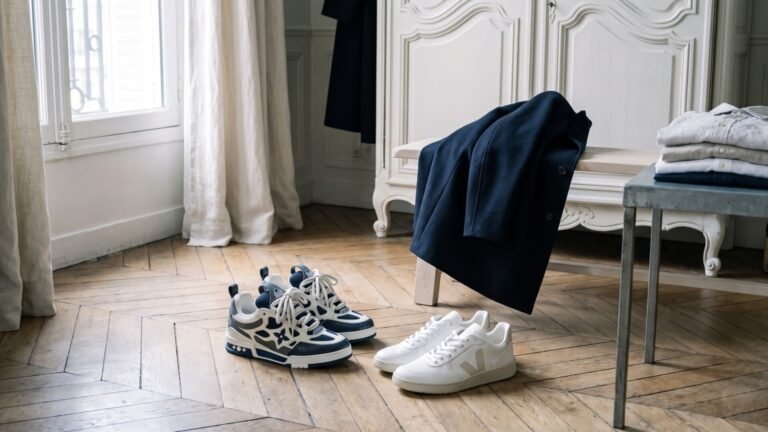
Veja: Sustainable Luxury Sneakers Redefining Fashion
Veja has carved a distinctive niche in the luxury sneaker market by proving that ethical production and contemporary design are not mutually exclusive. Founded in 2004, the French brand has grown from a niche eco-conscious label into a global phenomenon, spotted on everyone from the Duchess of Sussex to street-style influencers. This growth comes at a pivotal moment: as climate concerns reshape consumer priorities, Veja offers a compelling answer to the question of whether style and sustainability can coexist.
The brand’s appeal is not accidental. Veja has built its reputation on radical transparency, publishing its factory locations and detailing its supply chain in ways that most luxury houses avoid. This commitment resonates with a generation of buyers who increasingly scrutinize the environmental and social impact of their purchases. In a market saturated with greenwashing, Veja’s authenticity stands out.
This guide examines Veja’s value proposition from every angle: material quality, durability, styling potential, resale performance, and the true cost-per-wear. The central question is straightforward: Are Veja sneakers worth the investment for consumers who care about both aesthetics and ethics?
Thesis: Veja sneakers combine ethical production practices with contemporary design, making them a worthwhile investment for consumers looking to make a positive impact through their fashion choices.
[Explore the latest Veja collections to find your perfect pair](Affiliate: Shop Veja on SSENSE)
Quick Verdict Summary
Reasons to Buy
- Eco-Friendly Materials: Organic cotton canvas, wild Amazonian rubber, and recycled plastic bottles form the core of Veja’s construction. Veja publishes supplier information, and its rubber and cotton chains involve third-party social audits (such as FLO-Cert), though you should read the brand’s current disclosures.
- Timeless Design: The minimalist silhouettes and subtle branding align perfectly with the quiet luxury aesthetic that dominates premium fashion.
- Durable Construction: Lifespan varies widely with use and care; owner reports range from about one year to several years of regular wear.
Reasons to Avoid
- Higher Price Point: At roughly $160-$220 for the V-10 at US retailers (approximate, November 2026), Veja sneakers cost noticeably more than conventional canvas sneakers. The premium is justified by materials and ethics, but it remains a barrier for budget-conscious buyers.
- Limited Style Range: Veja’s design language is deliberately restrained. Buyers seeking bold logos, aggressive silhouettes, or avant-garde detailing will find the collection underwhelming.
Key Takeaway: Veja sneakers are an excellent choice for consumers prioritizing sustainability and style, despite their higher cost. The brand publishes more supply-chain detail than most, though you should judge its claims against its current disclosures.
Veja at a Glance
| Detail | Summary |
|---|---|
| Founded | 2004, Paris (Sébastien Kopp and François-Ghislain Morillion) |
| Made in | Factories in southern Brazil |
| Core materials | Organic cotton, wild Amazonian rubber, recycled plastic, leather described as chrome-free or vegetable-tanned |
| Approx. V-10 price (US, Nov 2026) | About $160-$220 at retailers |
| Best known models | V-10, Esplar, Campo |
| Best for | Minimal everyday sneakers with published supply-chain information |
Brand History
Veja was founded in Paris in 2004 by Sebastien Kopp and Francois-Ghislain Morillion, childhood friends who had worked at banks and then consulted on social and environmental projects. According to the brand, they traveled to Brazil and returned convinced that fashion could operate differently. Rather than creating a conventional brand and retrofitting sustainability later, they built Veja from the ground up with ethical production as the foundation.
The name “Veja” means “look” in Portuguese, a nod to the brand’s Brazilian roots and its mission to encourage consumers to look beyond the surface of their purchases. This philosophy extends to every aspect of the business. Veja sources wild rubber from the Amazon (harvested by tappers in Acre, Brazil, through local associations) and says it pays above the market price. Its organic cotton comes from small farms in northeastern Brazil, and the brand says it ships in recycled packaging.
What distinguishes Veja from many “sustainable” brands is its long-stated no-advertising policy. The company has said it relies on word of mouth and uses the savings to offset higher production costs; check whether the brand’s current policy has changed. The brand publishes its factory list openly, a level of transparency that remains rare in luxury fashion.
Veja’s trajectory from obscure ethical label to global brand is instructive for the wider industry. A 2013 retailer profile reported about 120,000 pairs sold in 21 countries in 2012; the brand is now sold far more widely, but we have not verified current volume figures. Its growth suggests sustainability can be a mainstream selling point. For the broader picture of French brands, our French luxury fashion houses guide provides context.
Sustainable Practices
Veja’s environmental credentials are not superficial. The brand has built its entire supply chain around reducing environmental impact, and the specifics matter for consumers evaluating the authenticity of its claims.
Materials
The upper of most Veja sneakers uses organic cotton canvas or a combination of organic cotton and recycled plastic bottles. Veja says its organic cotton is grown without pesticides or synthetic fertilizers by small farms in Brazil, and it cites independent certification and social audits (such as FLO-Cert); check the brand’s current certificates for specifics. This matters because conventional cotton is one of the most chemically intensive crops in agriculture.
The rubber soles are sourced from wild rubber trees in the Amazon, tapped by local collectors under fair trade agreements. This is a significant departure from the synthetic rubber used by most sneaker manufacturers, which is derived from petroleum. Veja says it pays rubber tappers above the market price, which it presents as an incentive to keep the forest standing.
Leather options, such as the Campo, use leather the brand describes as chrome-free or vegetable-tanned, which avoids the chromium used in conventional tanning. Check the product page for the tanning method of the exact model. The brand also incorporates recycled materials into its laces, linings, and packaging.
Production Ethics
Veja’s main factories are in southern Brazil, and the brand maintains direct relationships with each facility. The brand says workers are paid above the regional average and that its facilities undergo social audits. The brand does not own its factories, which some critics argue limits its control, but Veja counters that its long-term partnerships and premium payments create accountability that ownership alone cannot guarantee.
Carbon Footprint
Veja publishes impact information about its products. We have not verified any per-pair CO2 figure or industry comparison, so check the brand’s latest report before relying on a number. Veja has said it ships by sea rather than by air.
The environmental story is not perfect. Veja’s sneakers are not biodegradable, and the brand has not yet achieved circularity in its production. However, the company is transparent about these limitations, which paradoxically strengthens its credibility. In a market where brands routinely exaggerate their environmental achievements, Veja’s willingness to acknowledge imperfections is a marker of authenticity.
Design Aesthetics
Veja’s design philosophy is best described as restrained modernism. The brand’s sneakers feature clean lines, minimal branding, and a muted color palette that aligns with the quiet luxury movement dominating contemporary fashion. This is not accidental; the design team deliberately avoids trends in favor of timeless silhouettes that remain relevant across seasons.
The V-10
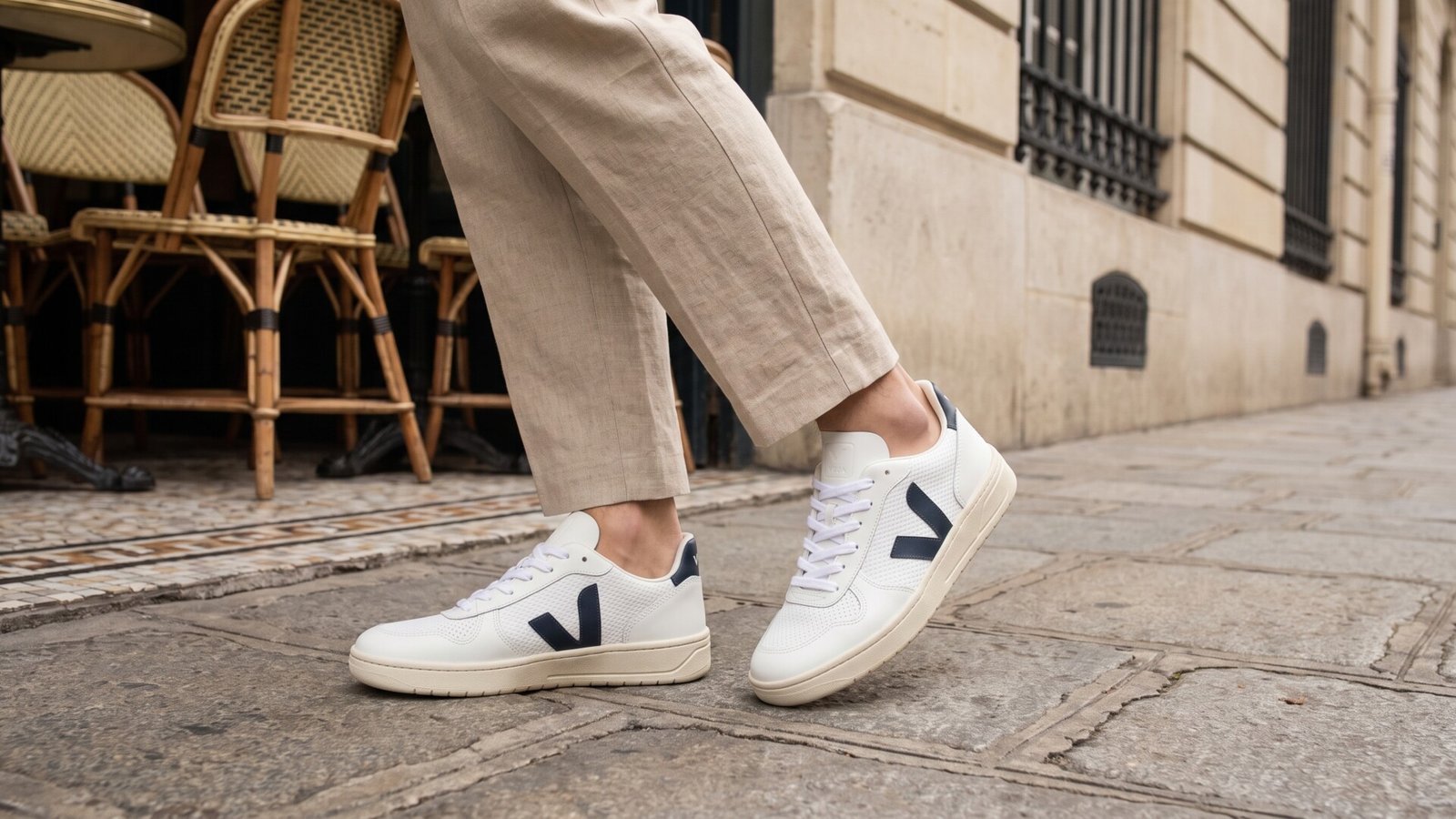
The V-10 is Veja’s most recognized model, distinguished by its “V” side panel in contrasting leather or suede. The silhouette is inspired by classic tennis shoes, with a streamlined profile and a slightly elevated sole. The V-10 works across casual and semi-formal contexts, pairing equally well with denim and tailored trousers. It is available in a wide range of colorways, though the most versatile options remain the white-on-white and white-with-black-V combinations.
The Esplar
The Esplar is a lower-profile alternative to the V-10, featuring a thinner sole and a more minimalist construction. The Esplar’s understated design makes it the preferred choice for consumers seeking maximum versatility. It reads as a “clean sneaker” in the tradition of Common Projects, but at a fraction of the price.
The Campo
The Campo is Veja’s leather sneaker, offering a slightly more polished aesthetic than the canvas models. The leather upper may develop character with wear, which appeals to buyers who like that look. The Campo is the strongest candidate for those seeking a sneaker that bridges the gap between casual and dressy.
Veja’s design language is deliberately consistent across models. The brand does not chase seasonal trends, which means its sneakers do not look dated after a year or two. This consistency is a double-edged sword: it ensures longevity but can feel repetitive to consumers who prefer variety. Compare current colorways and materials at retailers before choosing, as they change by season.
Quality and Durability
The durability of Veja sneakers is a subject of considerable debate among owners. The reality is nuanced: the brand’s quality is generally solid, but it is not exceptional for the price point.
Construction
Veja sneakers are assembled in factories in Brazil, and stitching is generally reported as consistent, though individual pairs vary.
Owners generally report the soles wearing reasonably well, but we have not verified a durability advantage over synthetic rubber. The soles are not replaceable in most models, which means the sneakers have a finite lifespan regardless of how well the uppers hold up.
Real-World Performance
Owner reports on lifespan vary widely; many describe roughly one to two years of regular wear, depending on usage. Those who rotate their sneakers and avoid wearing them in harsh conditions report significantly longer lifespans. The canvas models are more susceptible to staining and wear than the leather options, which is an important consideration for buyers who prioritize longevity.
The break-in period is a common complaint. The leather models, in particular, can feel stiff for the first week or two. This is not a defect; it is a characteristic of quality materials that soften and conform to the foot over time. Buyers who expect immediate comfort may be disappointed initially but are generally satisfied after the break-in period.
Comparison to Competitors
At roughly $160-$220 (approximate, November 2026), Veja faces competition from both conventional brands like Nike and Adidas and premium labels like Common Projects and Axel Arigato. Quality comparisons are subjective and we have not tested these brands side by side; Common Projects sells at a considerably higher price. The value proposition is therefore context-dependent: Veja offers above-average quality for its price, but it is not a “steal” in absolute terms.
Styling Versatility
Veja’s minimalist design makes it one of the most versatile sneakers on the market. The brand’s models can be integrated into a wide range of outfits, from casual weekend wear to smart-casual office attire.
Casual Looks
For everyday wear, Veja sneakers pair naturally with denim, chinos, and casual shorts. The white canvas models are particularly effective in summer outfits, while the leather options transition better into cooler months. The muted color palette ensures that Veja sneakers do not clash with other elements of an outfit, making them a safe choice for those who prefer a cohesive wardrobe.
Smart-Casual Contexts
The Esplar and Campo models can be worn with tailored trousers and blazers, particularly in creative or relaxed work environments. The key is to choose neutral colorways and ensure the sneakers are clean and well-maintained. Veja sneakers read as intentional rather than sloppy in these contexts, which is precisely the effect that quiet luxury buyers seek.
Demographic Appeal
Veja’s appeal spans age groups and fashion sensibilities. Younger consumers appreciate the brand’s environmental credentials, while older buyers are drawn to the understated design and comfortable fit. Veja also makes children’s sneakers.
Neutral colorways are the easiest to integrate into a refined wardrobe.
Investment Value
The term “investment” in luxury fashion typically refers to resale value, but for Veja, the more relevant metric is cost-per-wear. These sneakers are not collectible in the traditional sense, and their resale performance is modest. However, their durability and timeless design make them a sound purchase for consumers who value longevity.
Cost-Per-Wear Analysis
As an illustration, not a measured result: a $180 pair worn twice a week for two years (about 208 wears) works out to roughly $0.87 per wear. A $60 sneaker worn twice a week for six months (about 52 wears) works out to roughly $1.15 per wear. The comparison depends entirely on how long each pair actually lasts.
The calculus improves for buyers who maintain their sneakers and rotate them with other footwear: if a pair lasts longer than two years, the cost per wear falls further. We have not verified a typical lifespan beyond owner reports.
Fashion Trend Longevity
Veja’s design language is deliberately timeless, which reduces the risk of the sneakers looking dated before they wear out. The core silhouettes have stayed broadly consistent for years. Buyers can reasonably expect Veja sneakers to remain aesthetically relevant for the duration of their usable life.
Resale Market Insights
Veja’s presence in the resale market is limited compared to luxury sneaker brands like Nike’s Off-White collaborations or Adidas Yeezy. This is partly because Veja’s production volume is high and partly because the brand’s identity is built on accessibility rather than exclusivity.
Resale Performance
Pre-owned Veja sneakers usually sell well below retail on platforms like Grailed and Depop, depending on condition and model. Limited colorways and collaborations can command higher prices, but these are exceptions rather than the rule. Buyers should not purchase Veja sneakers as an investment; the resale value is a minor consideration at best.
What This Means for Buyers
The modest resale value is not necessarily a negative. It reflects the fact that Veja sneakers are designed to be worn, not preserved in boxes. The absence of a speculative resale market means that the retail price accurately reflects the product’s intrinsic value, which is a form of transparency that aligns with the brand’s philosophy.
Practical Ownership Experience
Real-world ownership of Veja sneakers involves several considerations that are not immediately apparent from product photos or marketing materials.
Fit and Sizing
Veja sneakers generally run true to size, though the fit varies slightly between models. Sizing advice varies by model and by owner, and Veja publishes its own size guide. Some buyers report that the V-10 fits snug and the Esplar runs slightly large, but treat that as anecdotal and check reviews for your exact model and foot width.
Check Veja’s size chart for the available size range and half sizes in your model.
Maintenance
Veja sneakers require regular care to maintain their appearance. The canvas models can be cleaned with a soft brush and mild soap, while the leather options benefit from occasional conditioning. The wild rubber soles are resistant to staining but can develop a yellowish tint over time, which is a natural oxidation process that is not a defect.
The laces are a common failure point, particularly in the canvas models. Replacement laces are inexpensive and widely available.
Comfort
The comfort level of Veja sneakers improves significantly after the break-in period. The wild rubber soles provide good shock absorption, and the organic cotton canvas is breathable. However, the insoles are relatively thin, and buyers who require arch support may need to replace them with orthotic inserts.
What Most Buyers Get Wrong
Several misconceptions about Veja persist, and addressing them provides clarity for prospective buyers.
The “Sustainable Premium” Misconception
Many buyers assume that Veja’s higher price is solely a “green tax” for sustainability. In reality, Veja’s prices are comparable to other premium sneaker brands that do not prioritize sustainability. Veja has said its no-advertising policy helps offset its higher production costs. The price premium relative to fast fashion reflects quality materials and fair labor practices, not marketing hype.
The Durability Overestimation
Some buyers expect Veja sneakers to last indefinitely because of their premium positioning. This expectation is unrealistic. Veja sneakers are well-made but not indestructible. The canvas models, in particular, are susceptible to wear and staining. Buyers who treat Veja sneakers as disposable will be disappointed; those who care for them properly will be satisfied.
The “Luxury” Label
Veja is often described as a luxury brand, but this classification is misleading. Veja’s prices are accessible relative to luxury sneakers from Gucci or Saint Laurent, and the brand’s aesthetic is deliberately anti-status. Veja is better understood as a premium brand that competes with the upper end of the sportswear market rather than with traditional luxury houses.
The Cost-Per-Wear Reality
The most important insight for buyers is that the cost-per-wear of Veja sneakers is competitive with fast-fashion alternatives when the full lifespan is considered. A $60 sneaker that lasts six months can cost more per wear than a $150-$180 Veja that lasts two years, though it depends on real lifespan. The difference is that the Veja pair offers better materials, a lower environmental impact, and a more timeless design.
Future Trends in Sustainable Fashion
Veja’s success is not an isolated phenomenon. It reflects a broader shift in consumer behavior that is reshaping the luxury fashion industry.
The Mainstreaming of Sustainability
Sustainability is moving from a niche concern to a mainstream purchasing criterion. Surveys regularly show consumers saying sustainability matters to their purchases, though stated intent and actual buying behavior often differ. We have not cited a specific survey here. This shift is particularly pronounced among younger consumers, who are more likely to research the environmental impact of their purchases.
The Limits of Greenwashing
As consumers become more sophisticated, brands that engage in superficial sustainability claims are facing increasing scrutiny. Veja’s transparency has become a competitive advantage, and other brands are being forced to follow suit. The next phase of sustainable fashion will likely involve greater supply chain traceability and more rigorous third-party certification.
The Future of Sneaker Design
Veja’s influence on sneaker design is evident in the growing number of brands adopting similar aesthetics. The minimalist, understated look that Veja popularized is now ubiquitous in premium sneakers. The next frontier is likely to be circularity: designing sneakers that can be fully recycled or biodegraded at the end of their life. Veja has made preliminary steps in this direction, but the brand has not yet achieved full circularity.
Emerging Alternatives
Several brands are challenging Veja’s position in the sustainable sneaker market. Cariuma and Allbirds also position themselves around sustainability, at different price points and with different aesthetics. Compare their published practices rather than assuming equivalence. These brands are not direct substitutes for Veja, but they indicate that the market is becoming more competitive. Veja’s continued success will depend on maintaining its authenticity as larger brands enter the space.
For other French brands at different price points, see our French luxury fashion houses guide.
Who Should Buy Veja
Veja sneakers are not for everyone, and understanding the target buyer is essential for making an informed purchase.
The Eco-Conscious Professional
The primary Veja buyer is someone who cares about the environmental impact of their purchases and has the disposable income to act on those values. These buyers are willing to pay a premium for products that align with their ethical standards.
The Quiet Luxury Adherent
Veja’s minimalist design appeals to buyers who prefer understated fashion over logomania. These consumers value craftsmanship and materials over visible branding, and they are drawn to Veja’s ability to deliver premium quality without ostentatious labels.
The Practical Minimalist
For buyers who want a single pair of sneakers that works across multiple contexts, Veja is a strong choice. The brand’s versatility reduces the need for multiple pairs, which aligns with minimalist wardrobe philosophies.
Who Should Avoid Veja
Buyers who prioritize maximum comfort out of the box should look elsewhere, as Veja’s break-in period can be frustrating. Those who prefer bold, trend-driven designs will find Veja’s aesthetic too restrained. And consumers on a tight budget should consider whether the sustainability premium is worth the higher upfront cost.
Keep Reading
Veja sits below the heritage houses on price. If you are weighing other French brands, these guides may help.
Related: Longchamp, Polène and Jacquemus, or return to the French luxury fashion houses guide.
Prices and policies change, so confirm details with Veja or an authorized retailer before buying.
Frequently Asked Questions About Veja
Are Veja sneakers true to size?
Most customers find that Veja sneakers fit true to size, though the fit varies between models. Some owners report that the V-10 runs snug in the toe box and the Esplar slightly large (anecdotal). Consult the brand’s sizing guide and consider your foot width before ordering.
How should I clean my Veja sneakers?
Veja recommends using a damp cloth and mild soap for cleaning. Avoid harsh chemicals and machine washing, which can damage the materials. For canvas models, a soft brush can remove surface dirt. For leather models, occasional conditioning will maintain the finish.
Are Veja sneakers worth the price?
For consumers who prioritize sustainability and style, yes. The sustainable materials and ethical production justify the higher price point, and the cost-per-wear is competitive with fast-fashion alternatives when the full lifespan is considered.
Can Veja sneakers be worn in wet weather?
Veja sneakers can withstand light moisture but are not waterproof. Avoid wearing them in heavy rain, as prolonged exposure to water can damage the canvas and affect the integrity of the rubber sole.
What materials are used in Veja sneakers?
Veja uses organic cotton, wild Amazonian rubber, and recycled plastic bottles in its most popular models. Leather options are vegetable-tanned, and Veja publishes supplier information; check its current disclosures for specifics.
How do Veja sneakers compare to other luxury sneaker brands?
Veja stands out for its commitment to sustainability, which most luxury brands do not prioritize. In terms of quality, Veja is comparable to premium sportswear brands but below traditional luxury houses like Common Projects. The value proposition is strongest for consumers who weigh environmental impact alongside aesthetics.
Where are Veja sneakers made?
Veja has said its main factories are in southern Brazil, with organic cotton and wild rubber sourced from Brazilian cooperatives and associations. Check the brand’s current supplier list for any changes.
How much do Veja sneakers cost?
The V-10 was listed at roughly $160-$220 at US retailers (approximate, November 2026). Prices vary by model, material and retailer, so confirm current figures before buying.
Is Veja a luxury brand?
Veja is better described as a premium sneaker brand. Its prices sit well below luxury houses such as Gucci or Saint Laurent, and its branding is deliberately understated.