The Best French Loafers for Men: From J.M. Weston to Paraboot
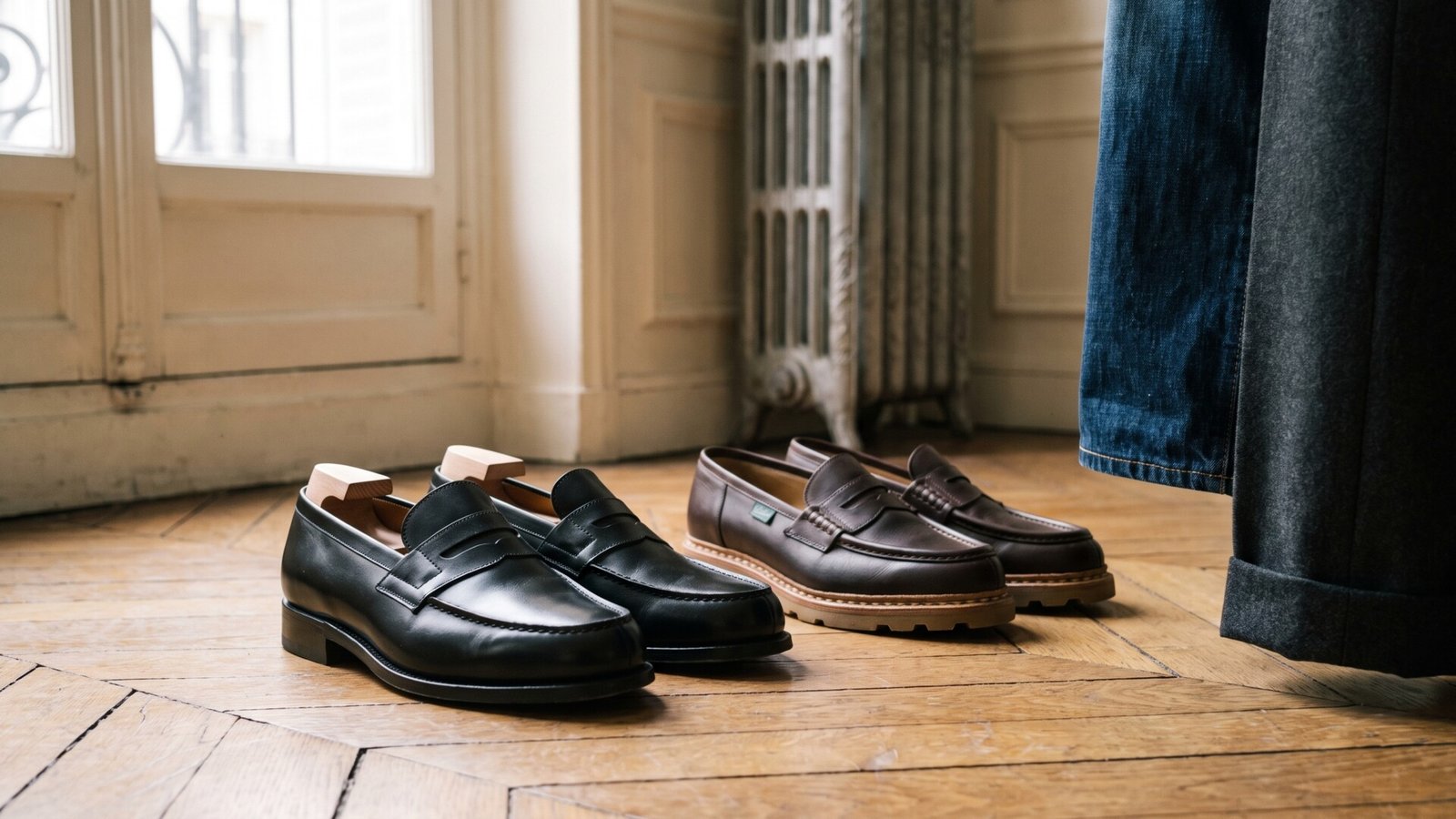
A good loafer is one of the few shoes that works with a suit, chinos and raw denim, and France has a real claim to the category. J.M. Weston reworked the slip-on into its 180 loafer in 1946, and the style became a fixture of Paris wardrobes from the 1960s. Around it sit other French makers with their own take on the slip-on: Paraboot in the Isère, Heschung in Alsace, and Corthay in Paris.
This guide compares those makers on what you can actually check: construction, leather, history, and where each fits in a wardrobe. It also corrects a common mix-up: the Paraboot Michael, often listed with loafers, is a derby. If you are building a wardrobe around buying once and keeping it, our heritage investment guide covers the wider logic, and the French shoes hub has the full category.
[Shop the best French loafers now]
Quick Verdict and Top Picks
| Need | Pick | Why |
|---|---|---|
| The classic French loafer | J.M. Weston 180 | Created 1946, Goodyear welted, made in Limoges |
| Rugged, rubber-soled loafer | Paraboot Reims, Orsay or Adonis | Built on Paraboot’s Michael-style lasts and rubber soles, more casual than Weston |
| City-casual with mountain roots | Heschung Mistral | Alsatian maker with Norwegian and Goodyear welting heritage |
| Parisian dress shoe house | Corthay | Founded 1990 by a former Berluti bespoke workshop manager; check current loafer range |
Best overall: the J.M. Weston 180. It is the shoe the category is measured against, and it is fully resoleable at the Limoges workshops.
Best for relaxed everyday wear: a Paraboot loafer. The soles are thicker and more weather-tolerant than a classic leather-soled loafer, and the look sits comfortably with denim and knitwear.
[Shop J.M. Weston 180] [Shop Paraboot loafers] [Shop Corthay]
What Makes a French Loafer Different?
French loafers tend to share a few traits: rounded, fairly high-volume lasts, restrained detailing, and welted construction that lets a cobbler replace the sole. They are less decorative than many Italian loafers and less formal than a British dress shoe, though that is a tendency, not a rule.
Construction in plain terms
Goodyear welt. The upper, insole and a leather strip (the welt) are stitched together, and the outsole is stitched to the welt. A cobbler can replace the outsole without disturbing the upper. J.M. Weston uses Goodyear welting across its range.
Norwegian welt. A more robust, visible stitched welt originally associated with boots, used by Paraboot and, in some models, Heschung. It is stronger and more water-resistant, at the cost of a chunkier profile.
The makers and what is documented
- J.M. Weston (1891). Founded in Limoges by Édouard Blanchard. His son Eugène spent time in Weston, Massachusetts, learning American manufacturing techniques and returned to Limoges in 1907 with knowledge of Goodyear welting; the J.M. Weston brand was registered in 1922. The 180 moccasin-style loafer followed in 1946, reworking a model the house had made since 1933. According to the house, the “180” refers to the number of handling operations, and the shoe was first called the Pantoufle. Weston describes a single factory in Limoges.
- Paraboot (1908). Founded by Rémy Richard-Pontvert in the Isère region of the Alps. Its best-known model, the Michael, appeared in 1945 as a rugged derby for workers and became a staple of French casual dress. Paraboot’s loafers, including the Reims, Orsay and Adonis, apply the same rubber-sole, hand-finished approach to a slip-on.
- Heschung (1934). Founded by Eugène Heschung in Steinbourg, northern Alsace, and passed through three generations of the family. Under Robert Heschung the house made competition ski boots from 1968 to 1972 and was the official supplier to the French national ski team. Its collections reinterpret both Norwegian and Goodyear welting, and its loafer range includes the Mistral.
- Corthay (1990). Pierre Corthay completed a six-year Compagnons du Devoir apprenticeship, worked at John Lobb’s Paris workshop from 1984, then at Berluti from 1985, becoming manager of its bespoke workshop in 1986. In 1990 he took over a workshop on rue Volney in Paris. Production moved to a factory in western France in 2013, where Goodyear welting is still used.
[Explore French loafer collections]
Top French Loafer Styles
J.M. Weston 180: the benchmark penny-style loafer
The 180 has a rounded shape with no ornament, a lace-free vamp with a jointed apron, a high toe box, and a thin, urban sole. It is Goodyear welted and can be resoled by the house. It is offered in several leathers and colors; J.M. Weston’s US site listed the men’s 180 in black boxcalf at about $895 at the time of writing, so expect roughly $900 and up depending on leather, with prices that change by market and season.
- Best for: Business-casual, suits, smart weekends.
- Watch for: Fit varies by width and last; try before you buy or use the house’s size guide.
Paraboot Reims, Orsay and Adonis: casual rubber-soled loafers
The Reims is described by retailers as a loafer version of the Michael, with reinforced hand-finished stitching at the instep and a deep opening that keeps the heel in place despite the thick sole. The Orsay is a penny loafer. Rubber “Marche” soles make these more weather-tolerant than a leather-soled loafer. Prices vary by retailer and model, so check current listings.
- Best for: Denim, chinos, travel, casual offices.
- Watch for: Chunkier profile; not a dress shoe.
Heschung Mistral: Alsatian city-casual
Heschung’s men’s loafer range includes the Mistral. Heschung’s heritage is in mountain and ski boots, and the house is known for combining Norwegian and Goodyear welting ideas. Check its site for current leathers, colors and pricing.
Corthay: the dress-shoe specialist
Corthay is best known for derbies, Oxfords and monks such as the Arca, a two-eyelet derby, rather than for a single signature loafer. If you want a dress loafer from a Parisian bespoke-trained maker, ask the house about its current slip-on models, and compare it with the way Roger Vivier approaches buckles and detailing if you want something more ornamental.
Bit loafers and other options
The metal-bit loafer is associated with Gucci, but French makers offer versions too; Paraboot, for instance, lists Reims bit loafers. Berluti, now part of LVMH, is another French name for slip-ons, including the Alessandro. For something more informal, see our best French designer sneakers.
[Browse all French loafers by style]
Materials and Craftsmanship
Leather
Box calf. Smooth, polished calfskin is the traditional dress finish and takes a shine well. Suede. Softer and more casual; it needs brushing and a protector spray. Exotics. Some makers offer exotic skins on request; ask the maker for care advice before using any product.
Tannery details are specific. J.M. Weston reports operating its own sole-leather tannery, the Tannerie Bastin in Saint-Léonard-de-Noblat; we could not confirm that the house owns the tannery behind its upper leathers, so earlier claims about owning the Du Puy tannery have been removed.
Soles
| Sole | Typical use | Trade-off |
|---|---|---|
| Thin leather (J.M. Weston 180) | Dry weather, office, dressier outfits | Less grip and weather resistance |
| Rubber (Paraboot Marche) | Wet weather, walking, casual | Chunkier, less formal |
[Shop by construction type]
Comfort and Fit
Welted leather shoes generally soften and mould to the foot with wear; the exact break-in time depends on the leather, the last and how often you wear them. We do not give fixed break-in times because we have not tested these shoes and no maker publishes one.
- Sizing: Each maker uses its own lasts, and French sizes differ from US sizes. Use the maker’s conversion chart, and try on in person if you can. We do not give a blanket “size down half a size” rule.
- Slip-on fit: A loafer has no laces, so the heel and instep need to hold the shoe in place. A good fit feels snug through the instep without pinching the toes.
- Socks: Many wear loafers sockless; no-show socks protect the lining and cut down on odor.
[Find your perfect fit]
Styling French Loafers
| Outfit | Loafer |
|---|---|
| Navy or charcoal suit, no tie | J.M. Weston 180 in dark brown or black |
| Chinos, navy blazer, oxford shirt | Brown box calf or suede loafer |
| Raw denim, knitwear, field jacket | Paraboot Reims or Orsay |
| Linen trousers or tailored shorts, summer | Suede loafer, no-show socks |
Dark brown is the most versatile color for a first pair. Black is more formal; a lighter suede or tan reads as summer. In the 1960s young Parisians wore the 180 sockless with jeans, a casual way of wearing it that is still popular today.
[Shop by styling need]
Price and Value in 2026
Of the pairs discussed here, only the J.M. Weston 180 has a price we could confirm from the maker (about $895 for black boxcalf on its US site). Paraboot, Heschung and Corthay prices vary by model, leather and market, and we could not verify current US figures. Check each maker’s site for current prices. As a rough way to judge value, divide the price by the number of times you expect to wear the shoe: a pair costing about $900 and worn weekly for ten years is roughly $1.70 per wear before resoling, which is why many buyers justify welted shoes.
[Check current pricing before increases]
Resale and Collectibility
Resale value for shoes depends on condition, size, leather and demand, and sizes outside the common range sell slowly. Worn shoes rarely resell near retail, so treat these as shoes to wear, not as assets. Earlier versions of this article quoted pre-owned price ranges and “investment potential” claims; we could not verify them and have removed them. If you plan to buy second-hand, compare sold listings and ask for sole and heel photos.
[Explore pre-owned French loafers]
Pros and Cons
| Brand | Pros | Cons |
|---|---|---|
| J.M. Weston 180 | Benchmark design; Goodyear welted; resoleable by the house | Higher price; thin sole is less weatherproof |
| Paraboot | Rugged, rubber soles; casual versatility | Chunkier, less formal |
| Heschung | Alpine and Alsatian heritage; welting expertise | Less widely stocked |
| Corthay | Parisian bespoke-trained maker | Loafers are not its core line; check current range |
[Compare all options side by side]
Who Should Buy French Loafers?
Good fit: men who want a shoe they can resole and wear for years, and who dress between smart and casual. A Weston 180 for city and work, plus a Paraboot for weekends, covers most situations.
Poor fit: anyone needing a hiking or work boot, anyone whose wardrobe is almost entirely sneakers (start with French designer sneakers), or anyone on a tight budget. Well-made loafers at lower prices exist from other countries, and the best choice depends on what you value.
[Determine if French loafers are right for you]
Care and Maintenance
- Smooth leather: Brush after wearing, then apply a cream polish when the leather looks dry. Saphir is a widely used polish brand among enthusiasts.
- Suede: Brush with a suede brush and use a protector spray before first wear; avoid heavy rain.
- Shoe trees: Cedar shoe trees help absorb moisture and keep the shape.
- Rotation: Give leather a day to dry between wears.
- Resoling: J.M. Weston repairs and resoles at its Limoges workshops, and welted shoes can generally be resoled by a good cobbler. Ask the maker or cobbler for a quote, since costs vary.
[Shop shoe care products]
Final Verdict
Best overall: J.M. Weston 180. It has a documented 1946 origin, Goodyear construction, house resoling and a design that works from boardroom to weekend.
Best casual alternative: Paraboot. The rubber soles and thicker profile suit denim and wet weather. Remember that the Michael itself is a derby; choose the Reims, Orsay or Adonis if you want a slip-on.
If you want a Parisian bespoke-trained maker: look at Corthay, and confirm its current loafer range with the house.
If you can buy only one pair, a dark brown J.M. Weston 180 is the safest bet. For more shoe ideas, browse the French shoes guide, the Sézane shoes guide, the Repetto Cendrillon vs. Miu Miu comparison, and our guide to the Hermès Oran sandal and its alternatives.
[Shop French loafers now before sizes sell out]
Frequently Asked Questions About French Loafers For Men
What is the best French loafer for men?
The J.M. Weston 180 is the benchmark. It was created in 1946, is Goodyear welted and can be resoled by the house. For a more casual, rubber-soled option, look at Paraboot’s Reims, Orsay or Adonis.
Is the Paraboot Michael a loafer?
No. The Michael is a derby, a lace-up shoe, introduced in 1945. Paraboot makes loafers such as the Reims, Orsay and Adonis on similar principles.
How much is a J.M. Weston 180 loafer?
J.M. Weston’s US site listed the black boxcalf version at about $895 at the time of writing. Prices vary by leather, market and time, so check the current listing.
Why is it called the Weston 180?
According to J.M. Weston, the name comes from the 180 handling operations involved in making it. The shoe was first called the Pantoufle.
How should French loafers fit?
Snug through the instep so the heel does not slip, with room for the toes. Each maker uses its own lasts and size chart, so try on in person or follow the maker’s conversion guide rather than relying on a general rule.
Can French loafers be resoled?
Welted construction, such as the Goodyear welt used by J.M. Weston, is designed to allow resoling. J.M. Weston offers resoling at its Limoges workshops, and a good cobbler can handle many welted shoes.
Are French loafers worth the price?
They can be if you will wear them often and resole them. A pair costing about $900 worn weekly for ten years is roughly $1.70 per wear. If you wear loafers rarely, a cheaper pair may be better value.
Where are French loafers made?
J.M. Weston makes its shoes in Limoges. Heschung is based in Steinbourg, Alsace. Corthay has a Paris shop on rue Volney and, since 2013, a factory in western France. Check the label of the specific model, as production can change.