Best French Designer Ballet Flats for Everyday Walking
If you intend to walk three miles a day, stop reading now. No French designer ballet flat will do that job, and the ones that pretend to are the worst of the category – a padded insole glued into a shoe that still has no structure under the arch. Buy a proper walking shoe and keep a pair of these in the bag for arrival.
The rest of this depends on what "walking" means in your week. Fifteen minutes to the office, a lunch errand, a dinner that ends with a taxi: the traditional ballet flat is fine, and the best of them is the Repetto Cendrillon. Several hours on hard pavement, a commute with two transfers, a travel day: the calculus changes, and a more structured flat earns its keep. This is a guide to which pairs survive real walking – not which look best on a shelf.
Quick Verdict Summary
Best overall: Repetto Cendrillon
The most honest expression of the French ballet flat: low profile, rounded toe, soft leather, almost no structure. It suits light-to-moderate walking, office days, dinners, and anything with cropped trousers or denim. It is also the pair most likely to be worn in five years without looking like a period piece.
The limitation is the sole. Thin, flexible, and elegant, which is exactly why it transmits every paving stone. Buy it for the walk from the car to the table, not the walk to the restaurant.
Best for a more polished wardrobe: Roger Vivier Gommette
A more defined shoe with the signature buckle and a firmer upper. It reads as deliberate with tailoring in a way the Cendrillon does not, and the structured shape holds the foot more securely. The price is higher, the branding more visible, and the hardware can press if the fit is not exact.
Best for a fashion-led wardrobe: Miu Miu ballet flats
The most contemporary interpretation, and the least predictable. Satin, straps, embellishment, and modern proportions vary by season, so comfort varies with them. This is a styling shoe. Treat it as one.
Reasons to avoid designer ballet flats for long walks
- Arch support is minimal to nonexistent compared with a walking shoe.
- Thin leather soles transmit impact and offer little protection from uneven ground.
- Narrow toe shapes and elasticized openings create pressure points when sizing is imprecise.
Key takeaway: Repetto Cendrillon is the best French ballet flat for light everyday walking and lasting style. If you regularly cover several miles, prioritize structure, sole, and fit over the traditional silhouette – or accept that you are carrying two pairs of shoes.
What Makes a French Ballet Flat Suitable for Walking?
Comfort in a ballet flat is not a brand attribute. It is the sum of five things: the upper, the insole, the outsole, the heel, and the fit. Get four right and one wrong and the shoe fails on the third block.
Upper construction. Soft lambskin and supple calf mold to the foot and reduce rubbing. Patent leather, coated finishes, and embellished uppers are stiffer and need break-in time. A very soft upper is not automatically better – it can collapse and stop holding the foot, which is how a flat starts slipping at the heel after a month.
Sole and insole. A thin leather sole is the traditional choice and the reason these shoes look the way they do. It is also the reason they feel every crack in the pavement. A rubber sole or a padded footbed changes the equation more than any other single factor. If walking distance matters, this is where to spend your attention.
Fit and foot shape. A well-fitted ballet flat holds the heel without gripping it, leaves room at the toe, and does not compress the forefoot. The elasticized opening should keep the shoe on, not clamp it. If the shoe is only comfortable when you size up, the last is wrong for your foot.
Walking profile. Be honest about the routine. Short errands and office days are intermittent walking – flexibility and a low profile matter more than cushioning. Commuting and sightseeing are continuous walking, and a traditional flat is a compromise there. The same shoe can be excellent for one and poor for the other.
For the wider context on how French shoes are built and where ballet flats sit within that tradition, the guide to French shoes from heels to sneakers is the place to start.
The Best French Designer Ballet Flats for Everyday Walking
Repetto Cendrillon – best overall
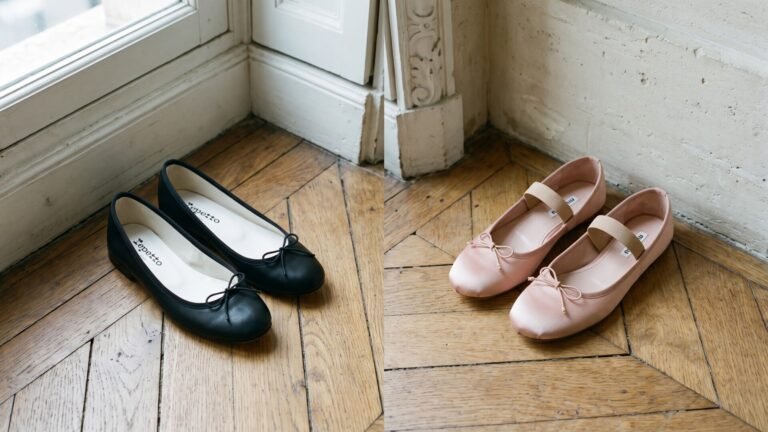
The Cendrillon is the reference point. Rounded toe, low vamp, soft leather, a sole thin enough to fold. It works with cropped trousers, straight denim, midi skirts, and dresses, which is most of why people buy it. The silhouette is quiet in a way that survives trend cycles.
The soft upper molds quickly, which makes the first weeks comfortable. The lightweight construction is the trade-off: on hard pavement the foot is under-protected, and after two hours of continuous walking the ball of the foot will tell you so.
This is a shoe for the buyer who wants a timeless French flat for moderate walking and understands what they are buying. It is not a technical comfort shoe and should not be judged as one.
Fit deserves care. The close silhouette can feel restrictive on wider feet, and sizing varies by style and material. Check the current guidance before ordering – the Repetto Cendrillon sizing guide covers how the shoe runs and what to do about a wide forefoot.
Repetto Camille – best for buyers who want a little more structure
The Camille is the more substantial Repetto. Slightly more presence on the foot, a shape that holds rather than drapes, and a construction that feels more reassuring over a full day. It remains recognizably Repetto, which is the point.
The trade-off is the loss of pure ballet-flat simplicity. The Cendrillon folds into a bag; the Camille does not. If that matters to you, it matters.
For buyers who like Repetto but want a pair that stands up to regular rotation, the Camille is the better daily choice. The comparison of the Cendrillon and Camille sets out the difference in shape, fit, and intended wear in more detail.
Roger Vivier Gommette – best polished designer option
The Gommette is a dressier flat. The signature buckle, a more structured upper, and cleaner proportions make it look intentional with tailoring in a way a soft ballet flat does not. For an office wardrobe built on navy, grey, and black, it finishes the outfit.
The defined shape also holds the foot more securely than an ultra-soft upper, which helps over moderate distances. The caveat is the construction: firmer leather, decorative hardware, and a more formal last can create pressure during long walks if the fit is not exact. Try before buying if you can, and if you cannot, buy from a retailer with a workable return policy.
The value question is cost per wear. As a versatile flat that moves from desk to dinner, it earns its price. As a dedicated commuting shoe, it does not. If you are weighing it against Roger Vivier’s other flat, the Belle Vivier versus Gommette comparison resolves which is more versatile.
Miu Miu ballet flats – best fashion-led option
Miu Miu treats the ballet flat as a fashion object rather than a heritage shoe. Satin, delicate straps, crystal embellishment, and modern proportions appear across seasons, and the versions are not interchangeable – a satin pair with a thin sole behaves nothing like a leather pair with a rubberized sole.
That variation is the problem for walking. Embellishment adds weight and pressure points, satin marks and stains, and delicate straps do not hold a foot over distance. These details improve wardrobe impact and reduce practicality at the same time.
Buy Miu Miu for styling and moderate use. Do not buy it as the most durable everyday pair, because it is not.
Chanel ballet flats – best recognizable luxury option
The two-tone cap-toe flat is the most legible piece of understated luxury in this category. No large logo, no hardware beyond the cap and the small interlocking mark, and a silhouette that works with almost everything. In beige and black it is close to a uniform.
Practical concerns are real. The materials are often delicate, light toe caps show scuffs and color transfer, and seasonal versions differ in sole, lining, and fit. The classic leather version is the more durable choice; the fabric and lighter seasonal versions are not.
Chanel is strongest as a style and status investment that happens to be wearable. It is not the most supportive option for long-distance walking, and it was never designed to be.
French Sole ballet flats – best accessible everyday alternative
French Sole occupies the space below the luxury houses: a French-inspired flat at a fraction of the price, useful for color rotation and frequent wear. The brand’s range is broad, and construction varies considerably across it.
That variation is the whole story. A simple leather flat with a decent sole can deliver excellent cost per wear. A thin-soled, lightly lined version will not, whatever the label says. Check the sole material, lining, and insole on the specific style rather than assuming the brand guarantees a standard.
For readers weighing accessible French footwear more broadly, the guide to Sezane shoes covers another option in the same bracket with sizing and comfort notes.
Walking Comfort Compared: Which Flat Works for Which Routine?
| Ballet flat | Best walking use | Comfort profile | Main limitation | Best buyer |
|---|---|---|---|---|
| Repetto Cendrillon | Short errands, office, light city walking | Flexible and lightweight, minimally cushioned | Thin sole and limited support | Classic-style buyer |
| Repetto Camille | Regular everyday wear | More structured than the Cendrillon | Less purely traditional in feel | Repetto buyer wanting practicality |
| Roger Vivier Gommette | Office-to-dinner, moderate walking | Secure and polished when correctly fitted | Firmer upper and decorative hardware | Refined wardrobe buyer |
| Miu Miu ballet flats | Fashion-led daily outfits | Depends heavily on the seasonal construction | Delicate details, variable comfort | Trend-aware luxury buyer |
| Chanel ballet flats | Smart casual and occasion wear | Elegant, moderate rather than technical | Delicate materials, limited support | Status-conscious classic buyer |
| French Sole ballet flats | Frequent rotation and light errands | Often practical for the price, model dependent | Less investment appeal | Value-conscious shopper |
For short errands and office days
The Cendrillon, the Camille, or a well-chosen French Sole. When walking is intermittent, flexibility and a low profile matter more than cushioning – you are on your feet for ten minutes at a time, not two hours. All three work with trousers, denim, and skirts, which is the practical test for a shoe you will wear four days a week.
For commuting and several hours on foot
Traditional ballet flats are a compromise here, and it is better to say so. Favor the more structured options, a rubber-soled variation where the brand offers one, or split the difference: a supportive walking shoe for the commute, the designer flat at the desk. Changing shoes protects the leather from pavement and weather and reduces fatigue. It is also what most people who own these shoes actually do.
For travel and city sightseeing
Do not make satin, patent, or heavily embellished flats your only travel shoe. Weather, uneven pavement, and unplanned distances will find every weakness. A durable leather flat with reliable heel hold is the safer choice, even if it is less visually delicate. If you want the designer pair for dinners, pack it separately and walk in something else.
What Most Buyers Get Wrong About Designer Ballet Flats
A soft upper does not guarantee comfort
Supple leather reduces rubbing. It cannot compensate for a thin outsole or a missing footbed. Buyers feel the softness in the shop and assume the rest follows. It does not. An overly soft upper can also collapse and crease, which is how a flat stops holding the foot after a season.
Flexibility is not the same as support
A shoe that folds in half is pleasant to hold and pleasing to pack. It also bends under the forefoot with every step, which is tiring over distance. Graceful flexibility and excessive flexibility look identical on the shelf and behave differently on pavement.
Sizing up is not a solution to a narrow toe box
Extra length creates heel slippage. It does not widen the forefoot. If a flat pinches across the toes, a half size up will give you a loose heel and the same pinch. Look for a different last, a rounder toe, or a wider construction instead.
Luxury pricing does not predict walking performance
Craftsmanship, heritage, and brand signaling are real. None of them is arch support. A less expensive leather flat with a rubber sole and a padded insole can be the smarter daily purchase than a prestigious pair with a thin leather sole – and it will hurt less to replace. The contrarian conclusion is uncomfortable but correct: for walking, the price tag is close to irrelevant.
Materials, Durability, and Ownership Costs
Leather versus satin, patent, and embellished finishes
Smooth leather is the most forgiving choice for frequent wear. It creases rather than cracks, takes polish, and hides minor marks. Satin shows water stains and snags. Patent scuffs visibly and cannot easily be repaired. Metallic finishes wear at the toe. Embellishment is a pressure point waiting to happen and a repair problem when it fails.
Reserve the delicate versions for controlled indoor wear and occasional outfits. If a pair will be worn three times a week, buy leather.
What tends to wear first
The outsole, the heel edge, the toe crease, the elastic opening, and the lining. On a thin leather sole, pavement wear appears quickly, and a cobbler visit may come sooner than expected. The toe crease is cosmetic but permanent. The elastic goes slack over time and stops holding the heel.
Inspect construction before purchase: a stitched sole, a reinforced heel counter, and a lined forefoot are the signs of a shoe that can be maintained. Ask whether the brand or a cobbler can replace the sole.
Maintenance that protects cost per wear
Rotate pairs rather than wearing one daily. Use shoe trees where the shape allows, protect leather from moisture, and keep light-colored flats away from dark denim and wet weather. Professional sole protection can improve practicality on pavement, but it changes the feel and appearance of the shoe – consider it before committing, not after.
Care is part of the true cost, especially for light colors and embellished finishes. A pair that needs a cobbler twice a year costs more than its sticker price.
Which pair still makes sense in three years?
The Cendrillon leads on timelessness – the silhouette has not dated in decades and will not start now. Chanel and Roger Vivier hold up as style investments if the buyer genuinely wears their design language. Miu Miu is more cautious: seasonal details date faster and are harder to repair or replace. French Sole leads on rotation and lower financial exposure, not on resale.
How to Choose by Foot Shape, Wardrobe, and Walking Distance
Best choices for narrow feet
Repetto styles with secure elastic or close-fitting openings, provided the shoe does not pinch. Heel hold is the priority. Avoid sizing up to gain comfort in the forefoot, which only creates slippage at the back.
Best choices for wider feet
Many ballet flats compress the forefoot because the shape is low and shallow. Prioritize rounder toes, softer leather, and more forgiving construction. A sharply tapered toe will not become comfortable with wear. If width is the main issue rather than brand preference, the guide to French designer shoes for wide feet is the more useful read.
Best choices for a quiet luxury wardrobe
The Cendrillon in restrained leather colors. Chanel’s understated two-tone designs. Roger Vivier styles without excess embellishment. Low branding, strong proportions, and neutral colors are what improve cost per wear – not the logo.
Best choices for a fashion-forward wardrobe
Miu Miu, and the more detailed Roger Vivier versions. Treat these as outfit-defining accessories rather than anonymous daily basics, and accept the maintenance that comes with them.
Best color for maximum wear
Black and dark brown have the lowest maintenance. Nude lengthens the leg and disappears against skin. Two-tone designs carry recognizable heritage appeal but show scuffs on the light toe. Burgundy is the underrated option – dark enough to hide marks, distinct enough to be interesting.
Investment and Resale Perspective
What gives a ballet flat lasting value?
Heritage, recognizable design codes, excellent condition, neutral colors, original packaging, and steady demand. Ballet flats are not handbags or watches in the resale market – they are worn, they crease, and the pool of buyers is smaller. Treat resale as a modest recovery, not a return.
Which pairs are most likely to hold wardrobe value?
The Cendrillon has the strongest timeless identity within the traditional category. Chanel benefits from recognition but is sensitive to condition and seasonal construction. Roger Vivier retains appeal among buyers who want the buckle. Miu Miu depends on current fashion relevance and the specific model. For a direct brand-level comparison of the two leading style directions, see Repetto Cendrillon versus Miu Miu.
Is one expensive pair better than several moderate pairs?
It depends on the wardrobe, and the framework is simple. Buy one premium pair when you have a consistent dress code and will wear the same silhouette four or five days a week – the cost per wear falls fast. Buy two or three simpler pairs when color rotation, weather, and daily use matter more, and when you would rather not expose a single expensive pair to rain and pavement five days a week.
The decisive point is that the best investment is the pair that matches your actual walking routine, not the pair with the highest price. A $700 flat worn twice a month costs more per wear than a $200 flat worn three times a week.
Final Buying Recommendation
Why Repetto Cendrillon wins
The most convincing combination of French heritage, timeless styling, lightweight comfort, and broad wardrobe compatibility. For light-to-moderate everyday walking it is the best answer in this category. It is not a substitute for a supportive walking shoe on a long city day, and it does not claim to be.
Why Repetto Camille wins for more structure
The better Repetto for buyers who want a less delicate-feeling option with more presence. It balances ballet-flat elegance with regular wardrobe use more successfully than the Cendrillon does, at the cost of some of the purity.
Why Roger Vivier Gommette wins for polished dressing
The strongest choice for office wardrobes and tailored clothing, and for buyers who prefer a finished designer statement. Accept the higher price and the firmer construction as part of the deal.
Why Miu Miu wins for fashion impact
The right choice when visual distinctiveness matters more than durability or all-day comfort. Buy it as a fashion investment and do not pretend otherwise.
Final conclusion
- Best overall: Repetto Cendrillon.
- Best for a more structured everyday wardrobe: Repetto Camille.
- Best for polished office style: Roger Vivier Gommette.
- Best for fashion-led dressing: Miu Miu ballet flats.
- Best for recognizable classic luxury: Chanel ballet flats.
- Best for lower-risk frequent rotation: French Sole ballet flats.
Explore the wider [Affiliate: French designer ballet flat collections] before committing to a model – the category moves with the seasons, and the pair that suits your routine is worth finding rather than settling for. Long-distance walkers should pair a supportive walking shoe with a designer flat for arrival and indoor wear. That is not a compromise. It is how these shoes were always meant to be worn.
Frequently Asked Questions About Best French Ballet Flats For Walking
Are French ballet flats good for walking?
For light-to-moderate walking, yes, when properly fitted. Most traditional styles lack the cushioning and arch support of a dedicated walking shoe, so judge them against the distance you actually cover rather than the distance you imagine.
Do Repetto ballet flats run small?
Fit varies by style, foot shape, and material. Check the current size chart and pay attention to forefoot width, heel security, and whether the upper is leather or a less forgiving finish. The Cendrillon’s close silhouette is the usual source of complaints from wider feet.
Which French ballet flats are best for wide feet?
Rounder toes, softer leather, and less restrictive openings are the most promising combination. Very shallow or sharply tapered styles are the most likely to pinch. Wider alternatives across French brands are covered in the wide-feet guide linked above.
Can you wear designer ballet flats all day?
Some wearers can, particularly in an office with intermittent walking. All-day comfort depends on foot shape, sole construction, surface, and break-in. Do not rely on a minimal flat for a full sightseeing day without testing it first.
Are Repetto Cendrillon ballet flats worth the price?
For buyers who value authentic French ballet heritage, a timeless silhouette, and frequent light-to-moderate wear, yes. They are less compelling for buyers who need cushioning, arch support, or heavy-weather durability – those buyers should look at structured alternatives or a different category entirely.
Which ballet-flat material is most practical?
Smooth leather. It is easier to maintain and more adaptable than satin, patent, metallic, or heavily embellished finishes. Follow the brand’s care instructions for the specific material.
Do French designer ballet flats hold their value?
Treat them as wardrobe investments, not financial ones. Repetto, Chanel, and Roger Vivier have stronger recognition than lesser-known styles, but condition, color, seasonality, and original packaging drive resale appeal far more than the original price.
The caveat is simple. The Cendrillon is the right flat for the reader who walks to lunch, to the office, to dinner, and not much further – and if that is not your week, the recommendation changes. Buy the structured pair, or buy the walking shoe and keep the beautiful flat in the bag. Both are reasonable. Neither is a compromise if you are honest about the distance.