Sézane vs Rouje: Which Brand Makes Better French Wardrobe Essentials?
If you are shopping for a single dress that has to do the work of an entire wardrobe, Rouje will disappoint you, and Sézane will not. If you already own the jeans, the coat and the plain knit, Rouje will give you something Sézane rarely does: a piece with a point of view.
That is the trade in one line. Sézane, founded by Morgane Sézalory in 2013, is the broader wardrobe brand, built for layering, repetition and the ordinary Tuesday. Rouje, founded by Jeanne Damas in 2016, is the narrower, more concentrated one, built around dresses, fitted cardigans and a specific romantic silhouette. Both sell a styled idea of French dressing. Neither is a guarantee of quality, and the Sézane vs Rouje question is settled by fabric, fit and frequency of wear rather than by the label on the neck.
Quick Verdict Summary
Sézane wins the default case. It covers knitwear, denim, blouses, outerwear, shoes and bags, layers more easily, suits work and repeated everyday wear, and gives better cost per wear when the buyer selects durable fibers and restrained silhouettes. Rouje wins a narrower argument, and wins it clearly: no Sézane piece creates the same immediate feminine, vintage-referenced effect as a well-chosen Rouje dress, which makes it the stronger choice for dinners, holidays and wardrobes built around dresses.
Choose Sézane for the foundation. Choose Rouje when the foundation already exists and the wardrobe needs a signature.
Before you order: the practical differences
Most comparisons stop at aesthetics. For a US buyer, the logistics differ just as much, and they decide how risky an online order is.
| Factor | Sézane (US) | Rouje (US) |
|---|---|---|
| Dress prices, full price | About $145-$275 | About $215-$310 (Arielle $215, Gabin $290) |
| Size range, dresses | US 2-14; knits XS-XXL | FR 34-44 (about US 2-12) |
| Typical dress fabrics | Organic cotton, linen, merino-cotton knits, some polyester | Viscose (often ECOVERO), cupro, lyocell |
| Typical dress care | Mostly machine-washable | Delicate 30°C wash or hand wash |
| Returns | 30 days; first return per order free | 15 days as standard |
| Free delivery | Varies; check at checkout | Orders from $300 |
Prices and policies are from the brands’ US sites as of November 2026 and change with the season. The decision rule this table supports: if you are unsure of your size or your style, start with Sézane, whose longer return window and broader size range forgive a wrong guess; order Rouje when you already know your Rouje size or can try it on. A single Rouje dress also sits just under the free-delivery threshold, so it pays to combine it with a second piece.
Sézane: The Broader Wardrobe Brand
Design philosophy and wardrobe role
Sézane designs for the whole day. A cardigan, a pair of straight jeans, a blouse and a leather bag can move from a desk to a dinner without changing anything but the shoes. Most brands sell one mood; this one sells a wardrobe.
The design language is deliberately less theatrical than Rouje’s. Trims are restrained, colors lean on ecru, navy, camel and black, and the details that date fastest – exaggerated shoulders, novelty hardware, loud prints – appear less often. The result is a lower failure rate per purchase.
The risk runs the other way. Sézane makes basics feel collectible, and a buyer can end up with four versions of the same cardigan in seasonal colorways, none of which earns its place. The discipline is to buy the core neutral and skip the limited edition.
Sézane pieces worth examining
The Gaspard cardigan is the piece most associated with the brand. It can be worn either way round, with the buttons at the front or down the back, which is a genuine functional advantage rather than a gimmick: two looks from one garment. Recent versions are a kid mohair, baby alpaca and polyamide blend, and some wearers size down for a closer fit. Fit varies by season and fiber, so check the current composition before committing; the Sézane sizing guide to the Jack and Gaspard cardigans is the place to start.
The Jack cardigan is the more casual option. Softer, less structured, easier to throw on. Buyers who want one refined layer should take the Gaspard. Buyers who want an everyday cardigan they will wear to death should take the Jack.
The Claude bag, around $450, is structured and polished, with a shape that holds its form when half empty – the quality that separates a useful bag from a collapsing one. The Milo is softer and more relaxed, better for weekends and for anyone who finds the Claude too formal. The Claude versus Milo comparison settles that choice in more detail than a product page will.
Denim, blouses and wool-blend outerwear complete the wardrobe rather than decorate it. None of these categories is the cheapest available. All of them are designed to be worn together, which is where the value sits. For how Sézane’s knitwear compares with a pricier Paris label, see Ami Paris vs Sézane on quality.
Materials, construction and quality questions
Sézane uses a wide spread of fibers: cotton, merino and other wools, alpaca, mohair, leather on the bags, and synthetic blends in some pieces. The Raquel shirt dress, for instance, is polyester, while the Felice midi is organic cotton made in Portugal. The composition changes by season and by product, so last year’s label tells you nothing certain about this year’s.
A natural fiber label is not a durability guarantee. Gauge, knit density, seam finishing, lining and hardware decide how a piece ages. A loosely knitted alpaca blend will pill quickly with regular wear no matter whose name is on it. A tightly spun merino will not.
Common ownership complaints are predictable. Softer knits pill under the arms and where a bag strap rubs. Cardigan plackets stretch if the garment is hung rather than folded. Dark denim can transfer onto light coats and pale leather. Bag corners wear first, as they do on any leather bag carried daily. The guide to Sézane knitwear and which wool blends pill covers the fiber question in depth.
Rouje: The Concentrated Aesthetic
Design philosophy and wardrobe role
Rouje sells a mood, and the mood is specific: feminine, body-conscious and vintage-influenced. The brand says its studio draws on vintage clothing, flea-market finds and retro details, and designs its floral prints in Paris. Dresses with a defined waist. Fitted cardigans. Blouses with a soft neckline. Prints, often floral, often small.
That concentration is the brand’s strength and its limit. A small wardrobe built around Rouje reads as deliberate and distinctive. A large one starts to look repetitive, because the pieces are designed to echo each other. Five Rouje dresses can feel like one dress in five fabrics.
The other consideration is adaptability. A fitted dress with a defined waist does one thing well. It does not layer under a coat as easily as a cardigan, does not move between a conservative office and a weekend, and does not forgive a size change. That is a fair trade for a buyer who wants the effect, and a poor one for a buyer who wants clothes that solve problems.
Rouje pieces worth examining
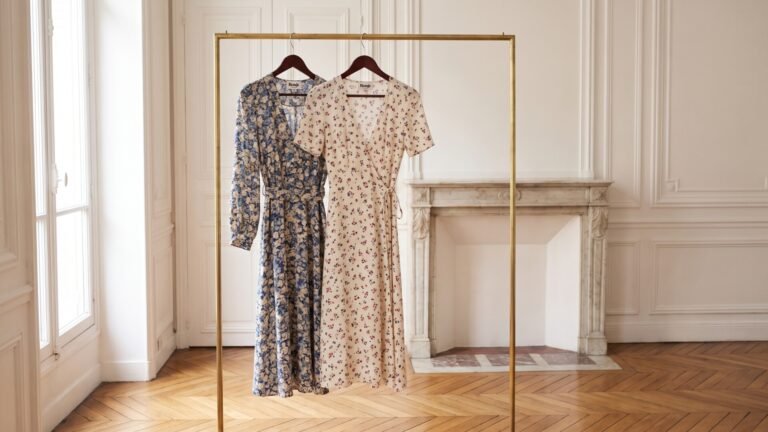
The Gabin dress, which Rouje calls its most iconic style, is the archetype: a wrap silhouette with a defined waist and a skirt that moves, reissued each season in new prints. A current 100% viscose version is $290, made in Romania and washable at 30°C. It flatters a range of figures because the waist is adjustable. It is a dress for a lunch, a dinner, a city weekend. It is not a commuting dress.
The Arielle dress, a printed sleeveless balconette style at around $215, leans further into the romantic register. More decorative, more memorable, slightly less adaptable. Buyers choosing between them should read the Arielle versus Gabin comparison, because the difference in versatility is larger than the difference in photographs.
Rouje cardigans are fitted and cropped by design. Worn with high-waisted denim or a skirt they create the proportions the brand is selling. Worn over anything bulky they do not work, and they are less forgiving across weight fluctuation than a relaxed Sézane knit. Blouses and skirts live or die on print scale and waist placement: a small print on a restrained cut will be worn for years, a bold print on a dramatic sleeve for one season.
Materials, fit and quality questions
Printed dresses and lighter blouses deserve close inspection. Check the fiber composition, whether the dress is lined, how the seams are finished, whether the closures sit flat, and whether the fabric is transparent in daylight. A summer dress that requires specific underwear is a dress that gets worn less.
Fit needs more attention than with Sézane. Rouje’s silhouettes are fitted through the bust and waist, so body measurements matter more than a size label. Rouje’s product pages give garment lengths and the model’s height and size, and length grows about 1 cm per size; compare those figures with a dress you already wear.
Care is heavier. Most Rouje viscose dresses take a delicate 30°C machine wash, but some cupro and lace pieces are hand wash only, and viscose can shrink temporarily when washed before returning to shape with ironing. Shaped knits want flat storage.
Head-to-Head Comparison
| Category | Sézane | Rouje | Better choice |
|---|---|---|---|
| Overall aesthetic | Polished, relaxed Parisian wardrobe | Feminine, vintage-inspired Parisian style | Depends on style identity |
| Wardrobe breadth | Strong across knits, denim, blouses, bags, outerwear | Concentrated around dresses, skirts, fitted separates | Sézane |
| Everyday versatility | Better for work, weekends and layering | Better for polished occasions and statement dressing | Sézane |
| Feminine impact | Refined rather than overtly romantic | Distinctly romantic and figure-conscious | Rouje |
| Fit flexibility | More varied, including relaxed silhouettes | Often fitted and shape-dependent | Sézane |
| Investment value | Stronger through repeatable basics | Stronger when the signature silhouette suits | Sézane for most buyers |
This is not a quality ranking. Neither brand is uniformly better made than the other, and item-level inspection matters more than the column heading. The real difference is breadth versus identity. Sézane solves more wardrobe problems. Rouje creates a more specific visual point of view, and a point of view is worth paying for only if it is yours.
Practicality: Which Brand Works Harder in Real Life
Work, commuting and daily dressing
Sézane offers more combinations. A cardigan, a blouse, a pair of trousers and a structured bag produce a week of outfits from four pieces. For offices with a conservative or business-casual dress code, the brand has appropriate options in most seasons.
Rouje can work in a creative or relaxed office. A plain dress with a blazer and flats is entirely reasonable. The problems arrive with prints, low necklines and fitted waists that make a dress feel like evening wear at ten in the morning. The guide to French designer workwear brands is useful for anyone trying to make either brand office-appropriate.
Travel, weather and layering
Layering decides this. Sézane’s cardigans, knitwear and relaxed outerwear go under a coat, over a shirt and across a temperature swing without a change of plan. A Rouje dress earns its luggage space when one dress serves several occasions – dinner, a gallery, a long lunch – with a change of shoes. That is a real efficiency, but a narrower bet: if the weather turns, a fitted dress has fewer answers than a cardigan. The comparison of French designer dresses for everyday wear is worth reading before committing a trip to one dress.
Maintenance and wear
Fine knitwear needs folding, not hanging. Printed dresses need careful washing and steaming. Structured leather bags need storage that holds their shape. Both brands carry a care burden; Rouje’s is higher because the silhouettes and fabrics are less forgiving.
The decision rule is simple. Buy Rouje when the piece will be worn often enough to justify its care. Buy Sézane when the piece can anchor several outfits a week.
What Most Buyers Get Wrong
Buying an entire aesthetic at once. Sézane’s version of French style is a curated mix of neutrals, texture and controlled color; Rouje’s is more overtly feminine and vintage-referenced. A wardrobe becomes convincing when one or two branded pieces sit among simple, well-fitting basics – plain tees, straight trousers, good shoes. Bought wholesale, either look reads as a costume.
Buying the most recognizable piece. The photographed cardigan and the floral dress sell the brand, but they are rarely the pieces that earn their keep. The test is unglamorous: does the item work with at least three outfits already hanging in the wardrobe, and in at least two seasons?
Letting brand positioning replace material scrutiny. Check fiber composition, construction, lining, closures and care on the specific garment in front of you. The same brand can produce an excellent coat and a disappointing blouse in the same season, and a beautiful dress can be poorly finished.
Investment Value, Resale and the Three-Year Test
Three questions do most of the cost-per-wear work. How many times a year will this be worn? How many existing outfits does it complete? What does it cost to maintain? A Sézane cardigan worn weekly from October to March beats a Rouje dress worn four times a year, even though the dress attracts more attention. That is not an argument against the dress. It is an argument for buying the dress knowing what it is.
At Sézane, prioritize restrained leather bags, classic cardigans, clean denim, simple blouses and tailored outerwear in wearable colors. At Rouje, prioritize less trend-dependent dresses, compact floral prints, refined cardigans and simple skirts, and avoid the exaggerated seasonal details that photograph best. Resale depends on fit, condition and current demand more than the label: a well-kept classic in a common size will find a buyer; a specific print in an unusual size will not.
Before buying either label, ask: would this still work if the brand vanished from social media tomorrow? Can it be styled with shoes, coats and bags already owned? Will the material tolerate the wear and care it requires? Sézane is generally the safer three-year wardrobe investment. Rouje is the better emotional purchase when the signature silhouette genuinely suits the buyer, and a piece worn with pleasure for three years is not a bad investment either.
Styling: Quiet French Wardrobe or Romantic Statement
Styling Sézane for quiet luxury
Texture does the work. A fine cardigan with straight denim. A leather bag against a plain blouse. A wool coat over understated knitwear. To keep the look from feeling branded, pair Sézane with unbranded shoes, tailored trousers and simple jewelry. The comparison of French designer cardigans is useful if the cardigan is the piece being chosen, since the category spans a wide price and quality range.
Styling Rouje without looking costume-like
Use restraint everywhere except the focal point. A Rouje dress with simple leather flats, a plain coat and minimal jewelry reads as French. The same dress with vintage shoes, a basket bag, red lipstick and a hair ribbon reads as a theme party. The rule is one vintage cue per outfit. A French designer blazer over a Rouje dress is one of the more reliable ways to make the brand work in a tailored wardrobe.
Mixing both brands
The hybrid wardrobe is the sensible answer for most buyers. A workable capsule: one Sézane cardigan in a neutral, one Sézane leather bag, straight-leg denim, one Rouje dress in a restrained print, a simple blouse and neutral shoes. That covers a week of ordinary days and most of the evenings in a month. The brands complement each other precisely because their strongest categories do not overlap.
Who Should Buy Which
Choose Sézane if
- The priority is a complete wardrobe rather than a single signature look.
- The week spans work, weekends, travel and layering.
- Relaxed or moderately tailored silhouettes suit better than fitted ones.
- Cost per wear and long-term utility matter more than immediate impact.
Choose Rouje if
- The wardrobe already has dependable basics and needs personality.
- Dresses, skirts and fitted knitwear are worn frequently.
- A feminine, vintage-inspired identity is the goal rather than quiet versatility.
- The buyer accepts that some pieces will be less adaptable and more care-intensive.
Avoid both if
- Luxury-house construction and materials are the expectation. Neither brand operates at the level of the established French luxury fashion houses, and neither claims to.
- The purchase is driven by trend recognition or social-media visibility.
- Measurements, fiber composition, care requirements and return conditions have not been checked.
Final Verdict
Sézane wins for most shoppers seeking French wardrobe essentials: more useful categories, more layering potential, more repeat wear, and a wider size range and return window that make it the safer online order. Rouje wins a narrower contest outright. For a distinctly feminine, romantic, vintage-influenced wardrobe, nothing in the Sézane range produces the same effect.
The considered approach is not to pick a side. Build the foundation with Sézane – knitwear, denim, a bag, a coat – and add Rouje selectively, where its signature silhouette offers something the everyday wardrobe cannot. For the broader context on how both labels sit within French dressing, start with the guide to French designer clothing and Parisian wardrobe essentials.
Frequently Asked Questions About Sézane Vs Rouje
Does Rouje run small?
Not as a rule, but Rouje’s dresses are cut close through the bust and waist, so there is little ease to spare. Rouje’s own pages usually say whether a style fits true to size and give the model’s height and size; use those notes and compare garment lengths with a dress you already own.
What is the return policy for Sézane and Rouje in the US?
Sézane allows returns within 30 days of delivery for unworn items with tags, and the first return on each US order is free. Rouje’s standard window is 15 days, though it extends returns over the holiday season. Check each site’s current terms before ordering.
Do Sézane and Rouje offer the same size range?
No. Sézane’s US site sizes woven dresses from US 2 to 14 and knits from XS to XXL. Rouje sizes dresses from FR 34 to 44, roughly US 2 to 12. Buyers above a US 12 will find far more choice at Sézane.
Can Rouje and Sézane dresses be machine-washed?
Many can. Sézane’s cotton and merino-blend dresses are generally home-washable, and most Rouje viscose dresses take a delicate 30°C machine wash. Some Rouje cupro and lace pieces are hand wash only, so read the care section on each product page.
Where are Sézane and Rouje clothes made?
Both list the country on each product page, and it varies by item. Recent Sézane dresses are made in Portugal, Bulgaria and China; recent Rouje dresses list assembly in Romania, Portugal and France, with fabric often woven or printed elsewhere.