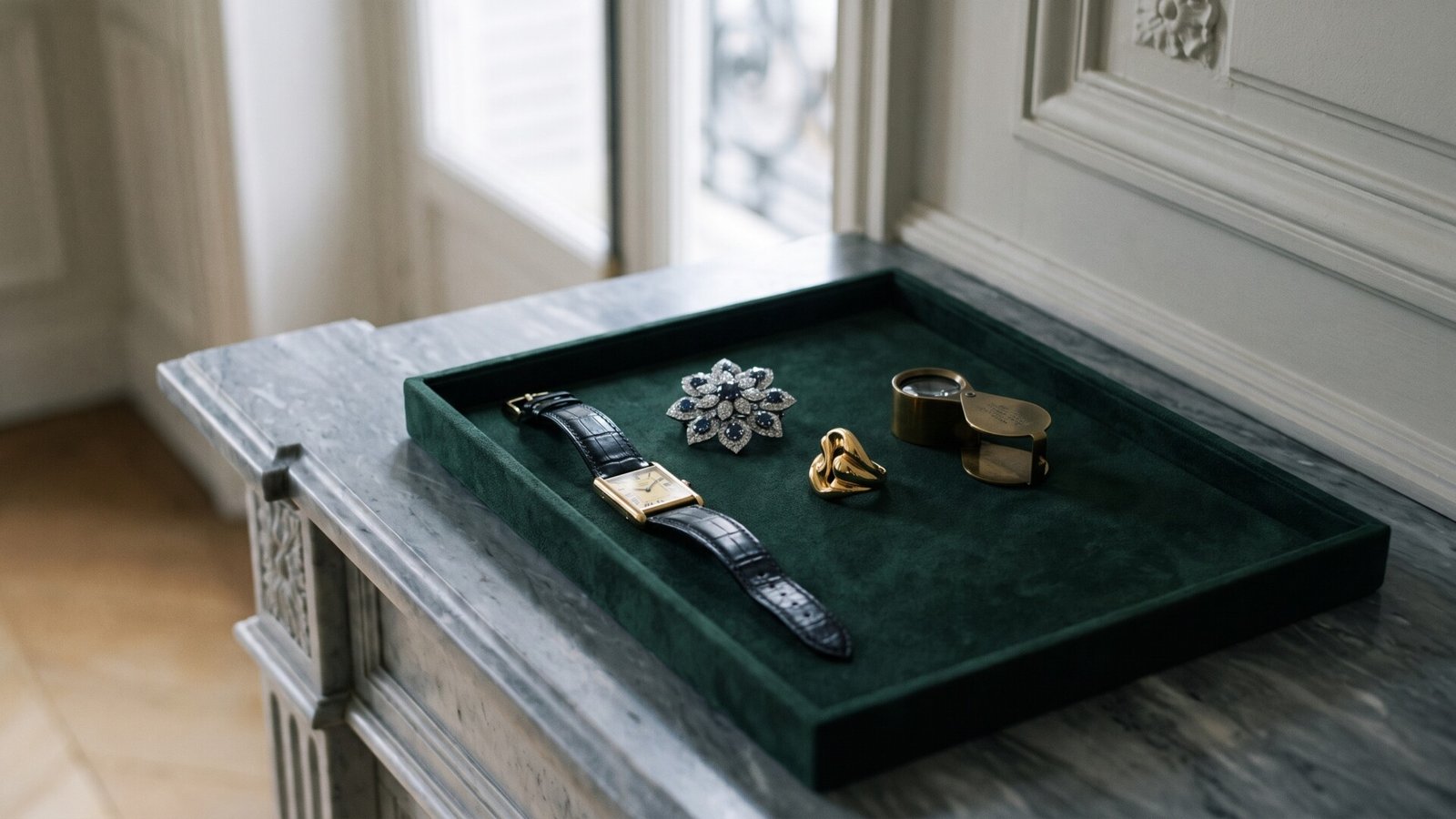
The Ultimate Guide to French Jewelry & Watches: Icons, Investments, and the Art of Timeless Elegance
French jewelry houses sell more than sparkle. The great maisons of Place Vendôme and the Rue de la Paix built their reputations on named techniques, documented design icons and, in the case of watches, genuine horological firsts. This guide separates what is well documented (founding dates, patents, launch years) from brand storytelling, so you can judge a piece on its facts.
Welcome to the French Jewelry & Watches hub at FrenchDesignerVault.com. It covers the four historic houses, the two most collected jewelry icons, the French watch families, and how to buy and resell with fewer mistakes. Prices are approximate, in USD, and change often, so confirm with the maison before buying.
New to the wider site? Our guide to French luxury fashion houses maps the maisons behind the jewelry, our Hermès guide covers its leather goods, and the Heritage Investment guides look at what is worth buying once and keeping.
What Makes French Jewelry Different?
At the heart of the tradition is Place Vendôme, the octagonal Paris square where the world’s most prestigious jewelers have clustered since the 19th century. The second ingredient is savoir-faire: techniques such as Van Cleef & Arpels’s Mystery Setting and Cartier’s design-led watchmaking that took generations to develop. The third is a willingness to experiment, combining precious stones with unexpected elements and drawing on nature, geometry and even industrial hardware, as the Cartier Love bracelet’s screws show.
The Four Historic Houses at a Glance
None of the four is independent today, which matters for service networks, pricing policy and how often prices rise. Each is owned by a luxury group, and each is known for a different strength.
| House | Founded | Owner | Known for | Pick it if you want |
|---|---|---|---|---|
| Cartier | 1847 | Richemont | Love, Panthère, Juste un Clou, Tank, Santos | Recognizable icons in jewelry and watches |
| Van Cleef & Arpels | 1906 (boutique at 22 Place Vendôme) | Richemont | Alhambra, Mystery Setting | Poetic, nature-inspired craft |
| Boucheron | 1858 | Kering (since 2000) | Quatre, Serpent Bohème, animal motifs | Bold design with history |
| Chaumet | 1780 | LVMH (since 1999) | Tiaras, Joséphine, Liens, Bee My Love | Imperial heritage and romance |
Cartier: The Jeweler of Kings
Cartier began in 1847, when Louis-François Cartier took over his master’s Paris workshop. His grandsons Louis, Pierre and Jacques expanded the house to New York, London and St. Petersburg, and the maison settled at 13 Rue de la Paix in 1899. King Edward VII is credited with calling it “the jeweler of kings and the king of jewelers.”
Its genius is in designs that become cultural shorthand: the Love collection, the Juste un Clou nail bracelet and the Panthère, which began as a diamond-and-onyx panther pattern on a lady’s wristwatch in 1914. In watches, the Santos, designed in 1904 for the aviator Alberto Santos-Dumont and sold to the public from 1911, is widely cited as one of the first men’s wristwatches, and the Tank, drawn in 1917 and sold from 1919, has a rectangular case said to be inspired by the tanks of the Western Front.
Louis Cartier also introduced the mystery clocks, whose hands seem to float on transparent dials, and the Tutti Frutti jewels of carved emeralds, rubies and sapphires inspired by Indian jewelry. Cartier is now part of the Richemont group rather than family-owned, but the red box remains an instantly recognizable signal of luxury, and its price rises are frequent enough that every figure in this guide needs a date.
What you need to know: Cartier is the most complete package, with historical weight, technical innovation and icons in both jewelry and watches.
Van Cleef & Arpels: The Poets of High Jewelry
Following the marriage of Alfred Van Cleef and Estelle Arpels, the house opened its first boutique at 22 Place Vendôme in 1906, where it remains today. Flowers, animals and fairies rendered in precious stones are its trademark, and its technical signature is the Mystery Setting (Serti Mystérieux), patented in France in 1933, in which stones are set on gold rails so that no prongs are visible. The technique is so labor-intensive that only a few pieces are made each year, according to the maison.
What you need to know: Van Cleef & Arpels is for the romantic buyer. If Cartier is about presence, this house is about beauty and wonder, and its Alhambra is the easiest way in.
Boucheron: The Adventurous Spirit of Place Vendôme
Frédéric Boucheron opened his first shop in the Palais Royal arcades in 1858, and in 1893 he became the first jeweler on Place Vendôme, at no. 26, reportedly chosen for its natural light. Boucheron has long mixed royal commissions with animal and nature motifs, and today it belongs to Kering, which acquired it in 2000. Claire Choisne has been creative director since 2011, and signature lines include Quatre and Serpent Bohème.
What you need to know: Boucheron is for the individualist who wants character and history without shouting.
Chaumet: The Tiara Specialist
With roots in 1780 and Marie-Étienne Nitot, Chaumet is one of the oldest jewelry houses in continuous operation, and it served Napoleon and Joséphine. The maison has worked from 12 Place Vendôme since 1907 and has been part of LVMH since 1999. It remains closely associated with the tiara, and newer collections include Liens, Bee My Love (a nod to Napoleon’s bee emblem) and the tiara-inspired Joséphine line, first shown in 2010.
What you need to know: Chaumet is history in wearable form, the choice for anyone drawn to imperial France and European royalty.
Which House for Which Buyer
| If you want… | Start with | Why |
|---|---|---|
| One piece to wear every day | Cartier Love bracelet | Plain gold, unisex, built to be worn constantly |
| A gift with nature and luck as the theme | Van Cleef & Arpels Alhambra | Clover motif, wide range of stones and motif counts |
| A slim dress watch | Cartier Tank Must | Lowest-priced Cartier watch family |
| One steel watch for daily wear | Cartier Santos | Quick-change bracelet, sportier case |
| Jewelry with character and an unusual story | Boucheron | First jeweler on Place Vendôme, animal and architectural motifs |
| A link to imperial France | Chaumet | Napoleon-era roots and a tiara tradition |
The same logic applies to budget: if one icon is all you will buy, choose the one you would wear on an ordinary Tuesday, because that is what you will actually own.
Iconic Pieces That Transcend Their Makers
The Cartier Love Bracelet
The Love bracelet dates to 1969, when the Italian designer Aldo Cipullo, then working for Cartier in New York, created a contemporary love token for the “make love, not war” generation. It is a plain gold band with screw motifs that are functional: the wearer is “locked” in with a screwdriver, which Cartier packaged with the original. The design was meant for men and women alike, a radical idea at the time, and its rivets echo the Santos watch.
Today the bracelet comes in yellow, white and rose gold, with or without diamonds, and as a classic bangle or a cuff that is easier to take on and off. The line has grown to rings, necklaces and earrings, including the softer Love Unlimited series. Boutique prices run from several thousand to well over ten thousand US dollars depending on model, metal and diamonds, so check Cartier’s US site for current figures. See the FAQ below for resale.
What you need to know: The Love bracelet is the usual entry to serious French jewelry collecting. Buy the best condition you can afford and keep the box and papers.
The Van Cleef & Arpels Alhambra
The Alhambra collection launched in 1968 around a four-leaf clover motif that had appeared in the house’s designs since the 1920s. The first piece was a long necklace of 20 motifs in creased gold edged with golden beads, and it went on to be worn by Grace Kelly, Romy Schneider and Françoise Hardy. The maison presents it as a new, everyday way to wear fine jewelry, which is brand storytelling, though the design’s lasting popularity is easy to verify.
Alhambra pieces range from single-motif pendants to 20-motif sautoirs, and price rises with each motif because of material and labor. Mother-of-pearl is the classic and most accessible material; carnelian, malachite, onyx and tiger’s eye are also used, and diamond-set versions sit at the top of the range. Five-motif bracelets are the most common configuration.
What you need to know: The Alhambra suits the buyer who values luck, nature and everyday wear. Because prices have climbed, counterfeits have become common, so buy only from the maison or an authenticated source.
Beyond the Big Four
The four historic houses share Place Vendôme with newer arrivals from fashion. Chanel keeps its high jewelry workshop above its boutique, Dior Joaillerie is among the square’s newest tenants, and Louis Vuitton has a jewelry workshop at 2 Place Vendôme. Mauboussin and Poiray (founded in 1975 by François Hérail and Michel Ermelin) are French jewelers on the same square with a more contemporary, less heritage-driven pitch, and Breguet, covered in the watch section, has a boutique there too. These fashion-house lines are worth knowing, but their secondary markets are thinner than those of Cartier or Van Cleef & Arpels, so resale is harder to predict.
French Watches: Cartier, Hermès, Chanel and More
French watches differ from Swiss ones in emphasis. Many French maisons are jewelers or fashion houses first and watchmakers second, so their watches tend to be design-led, with case shape or dial as the main attraction. Movements may be quartz or mechanical and come from specialist suppliers or the maison’s own manufacture, so check the exact reference.
Cartier Watches: Tank, Santos, Ballon Bleu and Panthère
Cartier is the benchmark French watch house. Third-party 2026 guides list entry-level US retail roughly as below, after the broad price increase they report for May 2026. Treat the figures as ranges, since they vary by size, movement, metal and bracelet.
| Collection | Approx. US retail (steel) | Character |
|---|---|---|
| Tank Must | $3,750-$4,400 | Slim rectangular dress watch, the most accessible Cartier |
| Panthère | From about $4,300 | Soft square case on a flexible bracelet, leans toward jewelry |
| Santos de Cartier | About $7,000-$9,000 | Square case with visible screws, quick-change bracelet |
| Ballon Bleu | About $5,300-$8,500 | Round case with a domed crown guard |
How to choose: the Tank Must is the usual first Cartier for a slim, dressy look; the Santos suits someone who wants one steel watch for daily wear; the Panthère is the most jewelry-like. Gold versions cost far more. For a specific reference, rely on Cartier’s product page.
Hermès, Chanel, Louis Vuitton and Breguet
- Hermès: known for the Arceau (1978) and the Heure H (1996), both with a strong design identity and leather straps. See our Hermès guide.
- Chanel: the Première (1987) and the ceramic J12 (2000) are its best-known watches. See our Chanel guide.
- Louis Vuitton: the Tambour, launched in 2002, is its core watch line. See our Louis Vuitton guide.
- Breguet: founded in Paris in 1775 by Abraham-Louis Breguet, it is historically French but now belongs to the Swiss Swatch Group and makes its watches in Switzerland, so it sits on the border of this category.
If you are weighing French design-led watches against Swiss technical ones, decide first whether you value case design and heritage or movement and finishing, because the two traditions optimize for different things.
How to Choose Your First French Jewelry or Watch
- Set a budget tier first. Below the Place Vendôme tier, most French designer jewelry is plated brass, vermeil or silver. Our guide to the best French designer jewelry under $1,000 covers A.P.C., Dior costume jewelry, Charlotte Chesnais and Sézane, and what you are paying for at that price. Entry-level maison pieces, such as the Tank Must, start in the low thousands, and gold icons run well into five figures.
- Choose the metal and finish you will wear daily. Yellow, rose and white gold age differently with scratches.
- Decide new or pre-owned. Pre-owned costs less, but you need reliable authentication, papers and a return policy.
- Plan for service. Mechanical watches and gold jewelry need periodic servicing and insurance.
Investment & Resale: The Smart Collector’s Approach
French jewelry can hold value, but no piece is a guaranteed investment, and many sell below original retail. Watches have the clearer data: third-party 2026 price guides report that pre-owned Cartier watches trade roughly 20 to 35 percent below current retail, with the Santos retaining the most value. For jewelry there is no reliable single figure, because value depends on the specific piece. Third-party guides also report a US price increase of roughly 6 percent on Cartier’s core watch collections on May 21, 2026, so check how recent the retail figure is before you compare a pre-owned price against it.
What drives value is consistent across houses:
- House and collection: Cartier, Van Cleef & Arpels, Boucheron and Chaumet have established secondary markets, and within each, Love, Alhambra and Panthère are the most liquid names.
- Materials and diamonds: precious metals and gemstones carry intrinsic value, and diamond-set pieces cost more at first.
- Condition and papers: well-kept pieces with the original box, certificates and receipts sell for more.
- Provenance and rarity: documented history, discontinued stones and limited editions can command premiums, though this is not predictable.
The practical rule: buy classic pieces in classic materials, buy the best condition you can afford, keep all documentation, and treat anything beyond that as a bonus rather than a plan.
Navigating the French Jewelry Market
Where to buy: Boutiques give you the full presentation, a warranty and the chance to build a relationship with a sales associate, and the Place Vendôme addresses (plus Cartier’s flagship nearby) are an experience in themselves. Auction houses such as Sotheby’s and Christie’s hold frequent jewelry sales with expert authentication. Specialist resellers can offer curated selections with authentication guarantees, so look for sellers with long track records and clear return terms.
What to check: hallmarks and serial numbers (each house uses its own system), the precision of settings and engraving, the weight and feel of the metal, visible condition, and original documentation. On a Love bracelet, look for a crisp, professionally executed serial-number engraving and a substantial weight, since an unusually light piece or thin plating that wears quickly points to a fake. On an Alhambra, examine the clasp, the beaded edging and the fit of the stone inlays, and ask for the original box, receipt and any service records.
The Bottom Line on French Jewelry & Watches
Each house offers something distinct: Cartier’s icons, Van Cleef & Arpels’s poetry, Boucheron’s adventurous spirit and Chaumet’s imperial grandeur. Know what you are buying, why it matters, and whether you are buying for love, for investment or, ideally, both.
Keep exploring: the French handbags guide, the French shoes guide, the French haute couture guide, the French perfume and beauty guide and our French vs. Italian designer comparisons. Prices, ownership and creative leadership change often, so check each maison’s official site for current details.
Frequently Asked Questions About French Jewelry And Watches
Which French jewelry houses are on Place Vendôme?
Van Cleef & Arpels (no. 22), Boucheron (no. 26) and Chaumet (no. 12) have historic addresses on the square. Cartier’s flagship is nearby at 13 Rue de la Paix.
Is the Cartier Love bracelet a good investment?
It has an active resale market, but pre-owned pieces often sell below retail and nothing is guaranteed. Condition, size, metal, diamonds and original papers all affect value, so treat it as something to wear first and a store of value second.
What is the Van Cleef and Arpels Mystery Setting?
It is a technique patented in France in 1933 in which stones are set on thin gold rails so that no prongs are visible, giving a continuous surface of gems. It is extremely labor-intensive, so few pieces are produced each year.
Which Alhambra material is the classic choice?
Mother-of-pearl is the most iconic and accessible option. Carnelian, malachite, onyx and tiger’s eye are also used, and diamond-set versions sit at the top of the range. Resale depends on condition, size and market timing rather than any guaranteed trend.
Are all French luxury watches made in France?
No. Many French maisons use movements or manufacturing from Switzerland or specialist suppliers, and Breguet is now owned by the Swiss Swatch Group. Check the exact reference, movement and case origin before you assume a watch is French-made.
How can I tell if a Cartier or Van Cleef and Arpels piece is real?
Check hallmarks and serial numbers, clasp mechanisms, stone setting and the weight of the metal, and buy only from the maison or a seller that authenticates and offers returns. Counterfeits of the Love bracelet and Alhambra are common.